

Each passenger is permitted to bring up to two items into the cabin: one carry-on bag and one personal item, with a total combined weight not exceeding 10 kg.
In addition, personal items must be stowed under the seat in front of you.
If you carry on board any baggage exceeding the carry-on baggage allowance, it may cause delay or cancellation of your flight. For a comfortable and safe journey, please check in baggage exceeding the permitted size for carry-on baggage before passing through security.
- For items that are not counted as personal items or carry-on baggage, please refer to the "Examples of Items Not Counted Toward Baggage Allowances" section below.
- Baggage Requiring Special Attention for Carry-on
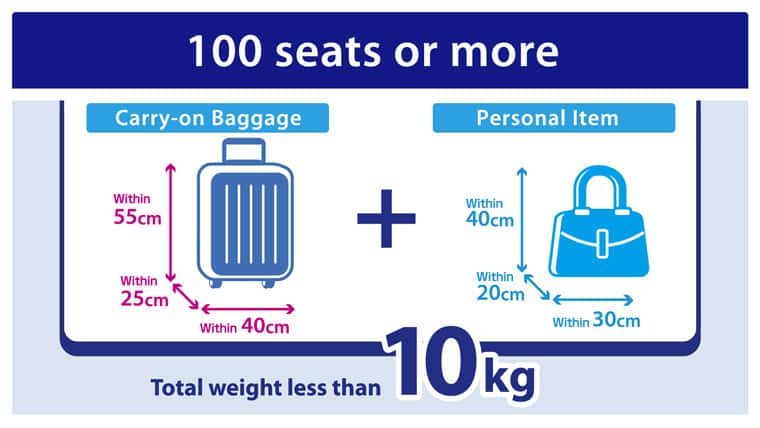
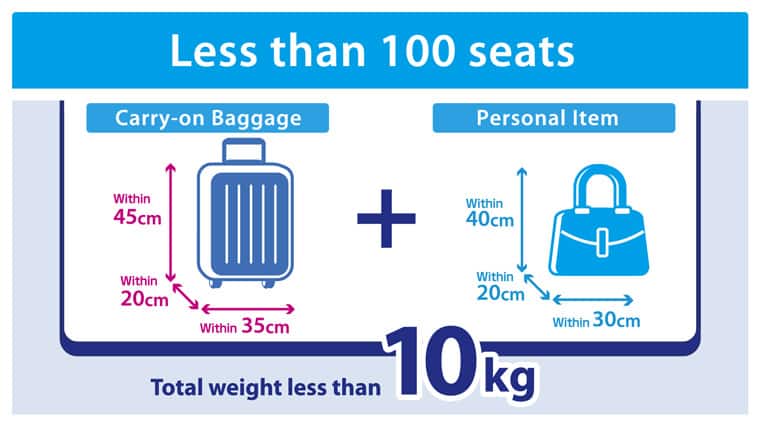
Carry-on Baggage Size and Rule
| Carry-on Baggage | Personal Item | |
|---|---|---|
| Typical examples | Suitcase, carry case, etc. | Handbag, shoulder bag, etc. |
| Number of Pieces | 1 piece | 1 piece |
| Size |
|
Within 40 cm × 30 cm × 20 cm |
| Weight | Up to 10 kg total per passenger (Total combined weight of the carry-on bag and personal item) |
|
| Where to stow | Overhead compartment / Under the seat in front of you | Under the seat in front of you |
- The rules regarding the size and where to stow personal items are based on the industry-wide guidelines for carry-on baggage established by the Scheduled Airlines Association of Japan, following administrative notice from the Civil Aviation Bureau of the Ministry of Land, Infrastructure, Transport and Tourism.
- Baggage dimensions include wheels and handles.
- To check the number of seats for your flight's aircraft type, please refer to the "Number of Seats by Aircraft Type" section below.
- Baggage size checkers (gauges) are available at the airport. Any baggage exceeding the carry-on size limits must be checked at the counter before passing through the security checkpoint.
- Please note that even if your baggage is within the allowable size limit, it may be stowed in the cargo compartment if cabin storage is unavailable.
- If you are carrying on board any baggage exceeding the carry-on baggage allowance, you will be required to pay the cabin baggage fees to purchase an additional seat. For details, please refer to the "Maximum Allowable Carry-on Size When Purchasing an Additional Seat" section below.
- For codeshare flights, the rules of the operating airline will apply.
- Star Alliance Gold members traveling across two or more member carriers are still limited to one piece of carry-on baggage.
How to Stow Your Baggage in the Cabin
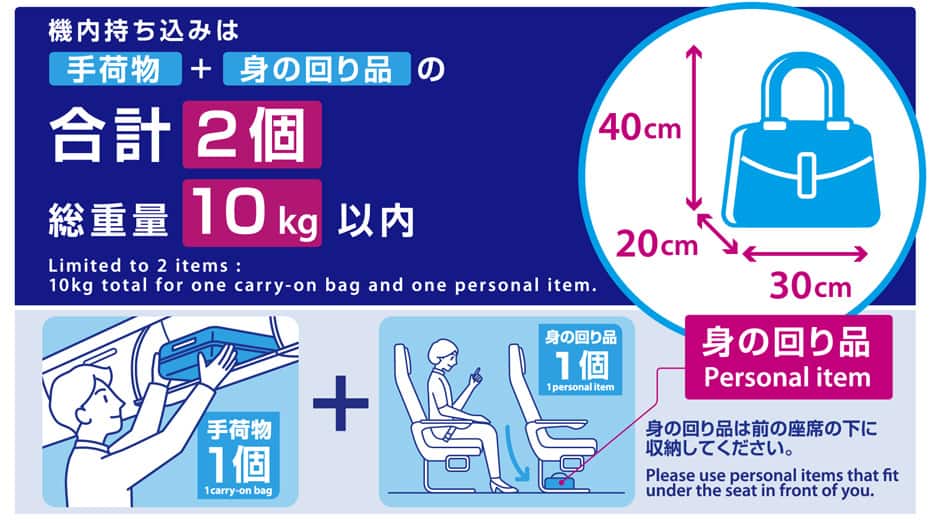
- Personal items must be stowed under the seat in front of you.
- Carry-on baggage is limited to items that you can stow by yourself either in the overhead compartments or under the seat in front of you.
- Please be aware that bringing on board baggage that you cannot stow by yourself has led to injuries and disputes between passengers.
- When stowing baggage in the shared overhead compartments, please ensure it is secured so that it does not slide or fall out when the door is opened.
- When stowing baggage under the seat in front of you, please ensure it is pushed completely underneath. Improperly stowed baggage may slide out during sudden impacts, potentially causing injury to yourself or other passengers.
- Leaving baggage in aisles, emergency exits, or any location that could obstruct evacuation during an emergency is prohibited by law.
- Baggage cannot be placed at your feet if there is no seat in front of you (e.g., seats in front of cabin monitors or bulkheads).
- If you wish to bring large items that cannot fit in the overhead compartments or under the seat in front of you (e.g., paintings or musical instruments), you will need to purchase an additional seat. For further details, please Reservation and Customer Service Center in Japan or the U.S.
-
The following situations may occur if baggage is not stowed properly.
-
Cause Injury
Your baggage may fly out of your hands in the event of a sudden impact, etc., and injure another passenger. -
Hinder Emergency Evacuation
Baggage may scatter across the aisles and the areas near the emergency exits, and could thereby hinder an emergency evacuation. -
Prevent You from Bracing for Impact
Having baggage on your lap will prevent you from bracing for impact in the event of an emergency.
-
Cause Injury
Examples of Items Not Counted Toward Baggage Allowances
- One coat
- One umbrella
- A child safety seat to be attached to the passenger's seat during the flight
- Crutches, walking sticks, prosthetic arms and legs to be used by person with disabilities
- Guide dogs, service dogs, and hearing dogs to accompany person with disabilities
- Bags containing infant or child items necessary for the flight
- Portable cradle for use with infants or children
- Other items specifically approved by ANA to be carried onboard
Number of Seats by Aircraft Type
You can confirm which aircraft type will be used for your flight on the Seat Availability Result screen for Japan domestic flights.
100 seats or more
B777-300 / B777-200 / B787-10 / B787-9 / B787-8 / B767-300 / A321 / A320 / B737-800
Less than 100 seats
DHC-8-400 / DHC8-Q200 / CRJ700 / ATR42-600 / ATR72-600
Maximum size permitted for carry-on baggage for passengers who have purchased a seat
- * For flights departing on or after {yyyy-mm-dd-2}, the descriptions on the reservation search page for Japan domestic flights have been changed from "Premium Class" and "Economy Class Seat" to "First Class (Premium Class)" and "Economy Class" respectively. There are no plans for any changes to the service following this change in terminology.
When baggage is placed on the flooring space in front of the seat and propped against and secured to the seat
Unit: cm
| Class | Width | Depth | Height |
|---|---|---|---|
| Premium Class | 45 | 55 | 130 |
| Economy Class | 45 | 20 | 130 |
When baggage is placed on the seat
Unit: cm
| Class | Width | Depth | Height |
|---|---|---|---|
| Premium Class | 50 | 40 | 70 |
| Economy Class | 40 | 40 | 70 |
- The maximum weight is 10 kg per seat.
- Passengers are kindly requested to secure their baggage to the seat by themselves.