Initiatives in Aircraft Flight Operations
Global Stance on the Environment
ICAO
ICAO has set a global target for improving international aviation fuel efficiency by an average 2% per year between 2021 and 2050. To achieve this goal, the ICAO adopted CNG2020 at its 2010 assembly as a mechanism to become greenhouse gas (CO2) neutral beginning in the year 2020.

CORSIA Adoption
The 2016 ICAO Assembly adopted an international aviation growth scheme for 2021 and beyond that does not increase CO2 emissions. This plan is called the Carbon Offsetting and Reduction Scheme for International Aviation, or CORSIA.
In 2022, due to the sharp decline in air travel demand caused by COVID-19, it was agreed to lower the baseline for calculating the offset amount (-15%), and ICAO States adopt net-zero 2050 global aspirational goal for international flight operations.
IATA
- Carbon-neutral growth beginning with the year 2020
- Generate an average 1.5% fuel efficiency improvement between 2009 and 2020
- Net-Zero Carbon Emissions by 2050 (4 October 2021)
ANA Group's Initiatives for Reducing CO2 Emissions from Aircraft
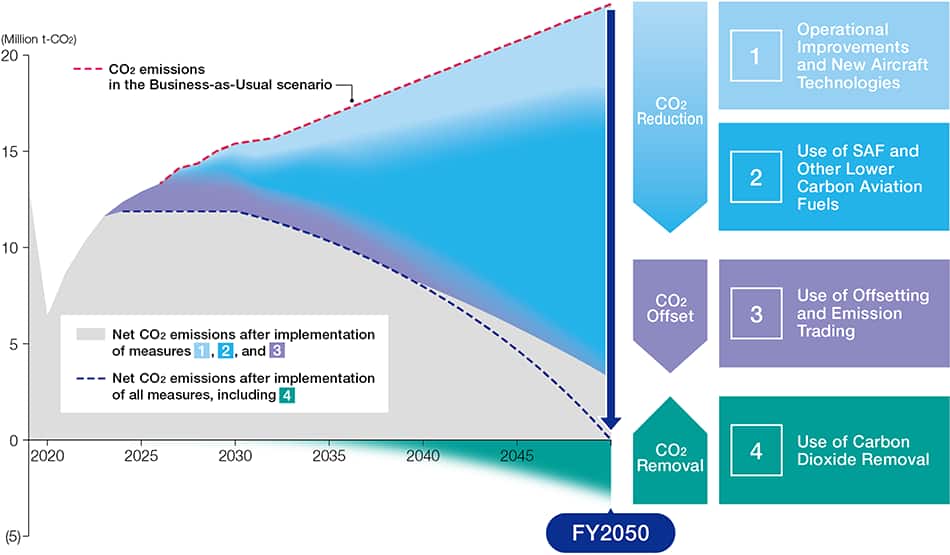
ANA Group has reviewed its mid-term environmental targets for FY2030 and transition strategy to achieve our decarbonization goals, and updated its transition scenario toward carbon neutrality by FY2050. By FY2030, we will reduce CO2 emissions on both international and domestic flights by at least 10% compared to FY 2019, net.
To achieve this goal, we will combine four strategic approaches (operational improvements and technological innovation of aircraft, etc., low-carbon aviation fuel through the use of SAF, emissions trading, and negative emission technologies*1), with the use of SAF at the core. We will achieve carbon neutrality by FY2050 while also pursuing compatibility with economic rationality.
- *1.Negative Emission Technologies(NETs): Capturing and sequestering CO2 from the atmosphere
Improving Flight Operation
"Operational improvements" can directly reduce CO2 emissions by reducing fuel consumption.The ANA Group is promoting this initiative at every stage of flight operations, centering on the Flight Operations Division.
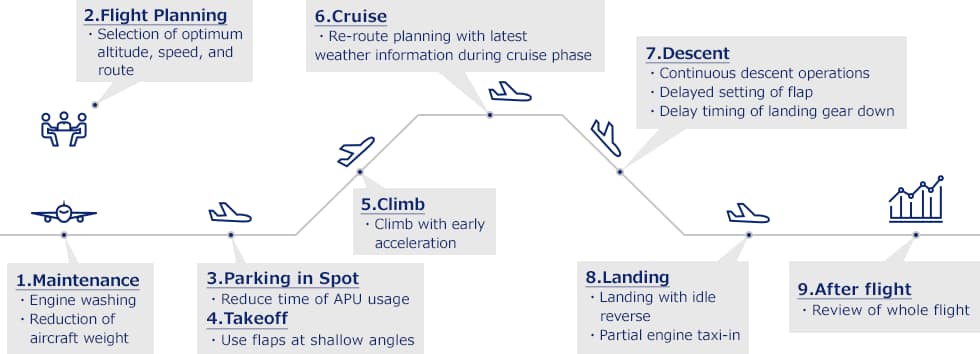
- 1.During Maintenance
- 2.Creation of Flight Plans
- 3.While parking Aircraft
- 4.Takeoff
- 5.During Climb
- 6.During Cruise
- 7.During Descend
- 8.Landing
- 9.Postflight
In addition to climbing with early acceleration and flap retraction during climb, reducing thrust reverser usage after landing, single-engine taxiing-in, fuel-efficient speeds, and other measures to date, in FY2024, we began visualizing CO2 emissions savings by shortening flight paths in cooperation with air transportation authorities as part of new fuel-saving activities.Through wide-ranging measures that include new initiatives, appropriate day-to-day weight management, and the use of ground power units and ground pre-conditioned air units, we reduced CO2 emissions by approximately 125,000 tons.
| FY | 2023 | 2024 | 2025 | |
|---|---|---|---|---|
| Target | Fuel (1,000kl) | 105 | 114 | 158 |
| CO2 (1,000t) | 83.0 | 90.0 | 125.0 | |
| Result | Fuel (1,000kl) | 114 | 158 | |
| CO2 (1,000t) | 90.0 | 124.9 | ||
- Measures
Early Acceleration and Flap Retraction during Takeoff/Reducing Thrust Reverser Usage/Single-Engine Taxiing/Shortening Flight Path/Other Measures
1.During Maintenance
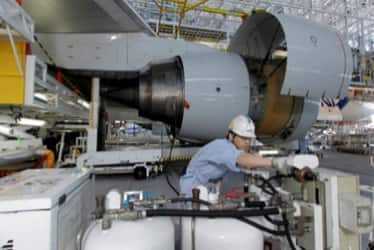
Water Cleaning Engines / Test Operations
The ANA Group has developed a unique vehicle for cleaning engine compressor parts. Engine compressor parts become dirty with each use, reducing fuel efficiency. Regular cleaning restores full engine function.
We have also revised test operations and introduced other efficiencies, saving 1% on annual fuel usage in test operations.
Reduction of Aircraft Weight
A lighter aircraft can fly on less fuel and reduce CO2 emissions. The ANA Group is working to optimize the amount of water supplied to aircraft and reduce the weight of onboard equipment.
For example, we are digitizing "TSUBASA -GLOBAL WINGS-" (in-flight magazine), changing the paper quality and reducing the number of pages for "Sky Shop"(shopping catalog), reviewing the amount of equipment, such as tableware and drinks, and removing the excess amount.
In addition, by digitizing manuals for both pilots and cabin crew, we were able to reduce the weight by 70%.

2.Creation of Flight Plans
Selection of Optimum Altitudes, Speed and Routes
Generally, fuel efficiency improves at higher altitudes due to lower air density, whereas excessive speed tends to increase fuel consumption. Because optimal conditions and routes fluctuate daily based on weather, pilots and dispatchers collaborate on every flight to select the most efficient altitude, speed, and flight path. For pilots operating multiple legs a day - such as on domestic routes - updated flight data is sent directly to their iPads between flights, allowing them to adjust and refine their flight plans using the latest real-time information.

3.While Parking Aircraft
Reducing the Time of Auxiliary Power Unit (APU) Usage
In addition to the wing-mounted engines, aircrafts are equipped with an Auxiliary Power Unit (APU) located in the tail. The APU provides the compressed air necessary for engine starts and cabin air conditioning, as well as the electrical power required while the aircraft is on the ground. However, because the APU burns jet fuel and generates CO2, we prioritize the use of Ground Power Units (GPUs). By connecting to these external ground-based sources for electricity and air conditioning while parked, we can significantly reduce APU runtime and lower our overall carbon emissions.
4.Takeoff
Reduced Flaps at Takeoff
Flaps are high-lift devices used to increase the wing's surface area and curvature during takeoff. While a higher flap setting allows an aircraft to lift off from shorter runways, it also generates significant aerodynamic drag, requiring higher thrust and increased fuel consumption to climb or accelerate. In contrast, when taking off from longer runways, pilots can use a "Reduced Flap" setting. This minimizes drag and fuel burn, leading to a more efficient ascent and a reduction in overall CO2 emissions.
5.During Climb
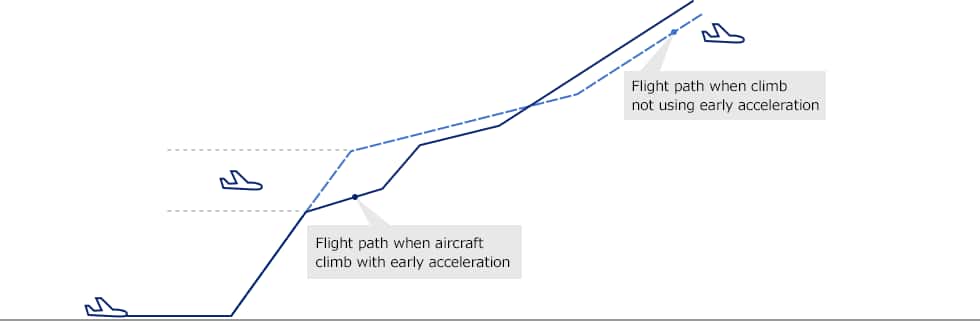
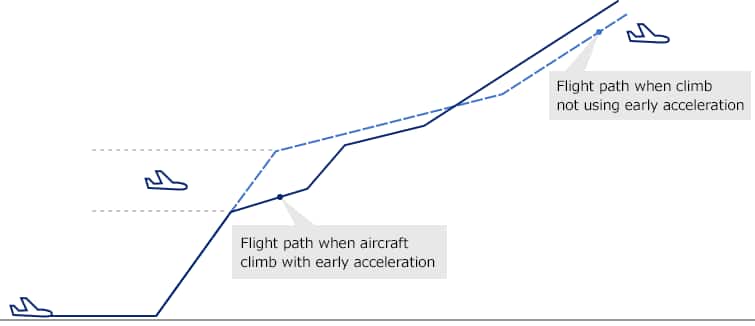
Climb with Early Acceleration
Climbing with acceleration at lower altitude after takeoff, retracting the flaps and reaching cruise altitude as soon as possible, enables to reduce fuel consumption.
6.During Cruise
Reviewing Flight Paths during Flight Using the Latest Weather Information
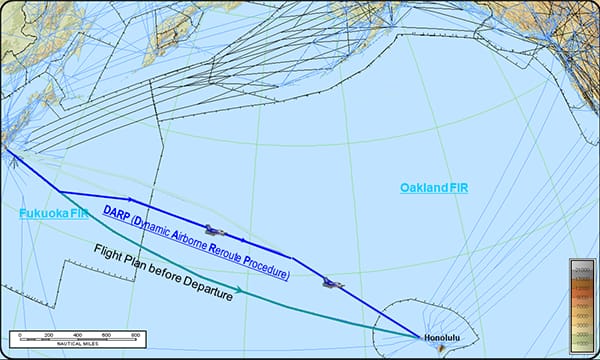
In addition to creating a flight plan, the ANA Group checks weather information again after takeoff, and changes flight routes depending on the situation. This is called DARP (Dynamic Airborne Reroute Procedure).
This allows for more optimal fuel planning and flight routes, thereby reducing CO2 emissions.
7.During Descent
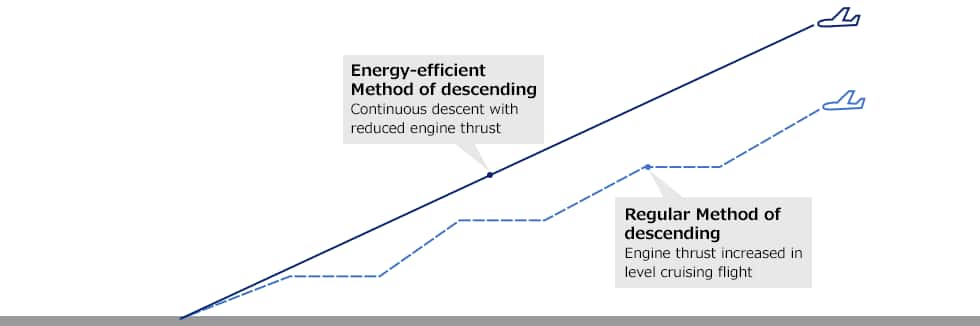
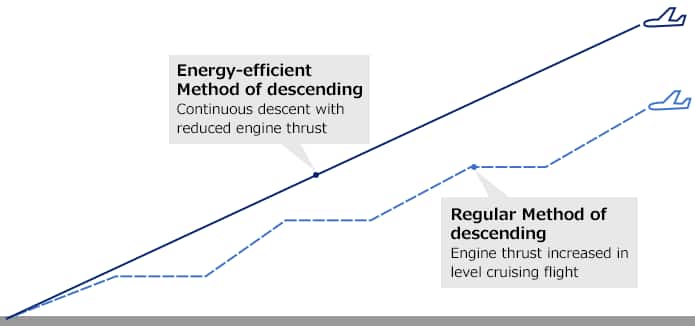
Promoting an Energy-Efficient Descent Method
Continuous Descent Operation allows an aircraft to maintain a steady, uninterrupted glide from the start of its descent until the final approach point. Unlike traditional arrivals that involve 'step-down' segments with periods of level flight, Continuous Descent Operation minimizes engine thrust and reduces flight distance. This approach significantly lowers fuel consumption, CO2 emissions, and noise pollution. The ANA Group initially implemented this method for late-night and early-morning flights at Kansai International Airport and is currently collaborating with relevant authorities to expand its use to other airports.
Optimizing Flap Deployment Timing
To slow down for landing, aircrafts deploy flaps to increase lift and drag. However, because extending flaps significantly increases aerodynamic resistance, pilots delay deployment as long as safely possible. By maintaining a "cleaner" aerodynamic profile for a longer duration during the approach, we can reduce engine thrust requirements, thereby lowering fuel consumption and CO2 emissions.
Delayed Landing Gear Extension
Similarly, the landing gear creates substantial drag once lowered. To maximize efficiency, the extension of the landing gear is delayed until the final stages of the descent, provided all safety and stabilization criteria are met. Delaying the gear extension minimizes noise and fuel burn, contributing further to our carbon reduction goals.
8.Landing
Minimizing Thrust Reverser Usage
After touchdown, aircrafts utilize a combination of wheel brakes and thrust reversers to decelerate. While thrust reversers redirect engine airflow to slow the aircraft quickly, they require an increase in engine RPM, which consumes additional fuel. When runway length and safety conditions permit, pilots use "Idle Reverse" (lowering engine power during reversal). This practice reduces fuel burn, lowers CO2 emissions, and significantly minimizes noise pollution around the airport.
One-Engine-Taxi-In
Once an aircraft has exited the runway, a single engine often provides sufficient thrust for taxiing to the gate. After verifying weather conditions and the surrounding environment for safety, pilots may shut down one engine and taxi using only one engine. This technique—known as One-Engine-Taxi-In—meaningfully reduces ground-level fuel consumption and carbon emissions.
9.Postflight
As a postflight procedure, the ground staff reviews and analyzes the flight data, and utilizes it for daily operations as well as for reducing environmental impact.
The ANA Group presents the "ANA's Way AWARDS" to recognize efforts made by individual employees that have contributed to creating value for the ANA Group, improving the brand, strengthening corporate culture, and fostering a sense of unity within the Group. Awards are given in a variety of categories, including "Safety" and "Sustainability," with the aim of promoting a cycle of improving productivity and strengthening team spirit that transcends departments and companies.
Adopting New Aircraft Technologies
Introduction of Fuel-Efficient Aircrafts and Engines
As the global launch customer for the Boeing 787 Dreamliner, we celebrated a decade of its fuel-efficient service in 2021. As of June 2025, the ANA Group operates a fleet of 86 Dreamliners (across the -8, -9, and -10 variants) and continues to integrate state-of-the-art aircraft like the Airbus A320neo and A321neo. By the end of March 2025, fuel-efficient models will account for 82.7% of our jet fleet.
Looking ahead, we have finalized a purchase agreement for the Boeing 737-8, with deliveries scheduled for FY2026 and beyond. Our goal is to expand our Boeing 787 fleet to over 100 aircraft by FY2030 as part of our commitment to rapid fleet renewal. Furthermore, we are conducting a demonstration project to apply a "shark-skin" (riblet) filmOpens in a new window.In the case of an external site,it may or may not meet accessibility guidelines. to aircraft surfaces. This specialized finish reduces friction during flight, further driving down fuel consumption and CO2 emissions.
Airframe modifications
First aircraft with Riblet technology implementation in service
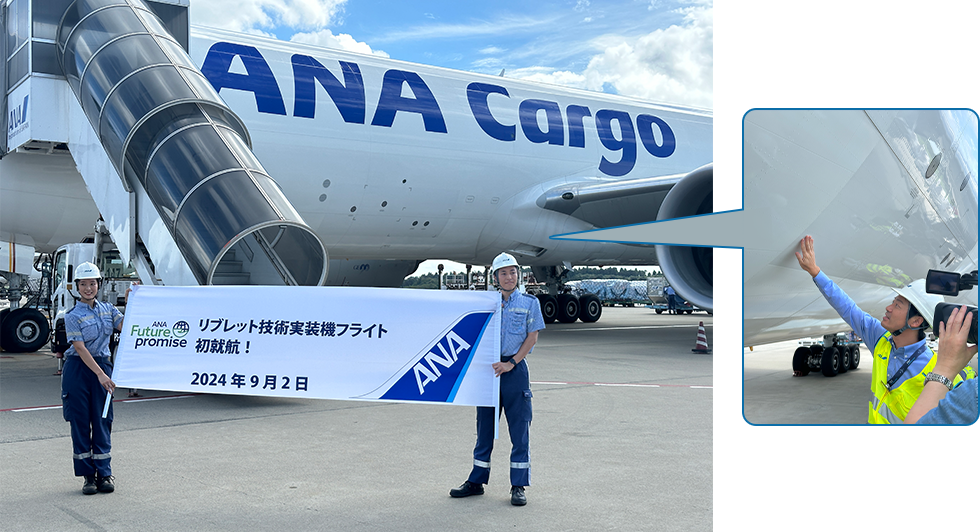
ANA becomes the first individual airline in the world to equip both passenger and freighter version of the Boeing 777 with fuel-saving AeroSHARK technology, reducing drag and emissions. The first modified Boeing 777F (JA771F) with AeroSHARK technology began scheduled cargo flights and was later extended to a passenger aircraft (JA796A) in the spring of 2025, furthering ANA's commitment to investing in fuel-efficient technologies that reduce emissions.
It results in estimated annual savings of approximately 250 metric tons of fuel and 800 metric tons of CO2 for each aircraft.
(Maximum predicted effect calculated by Lufthansa Technik based on ANA's average annual flight hours)
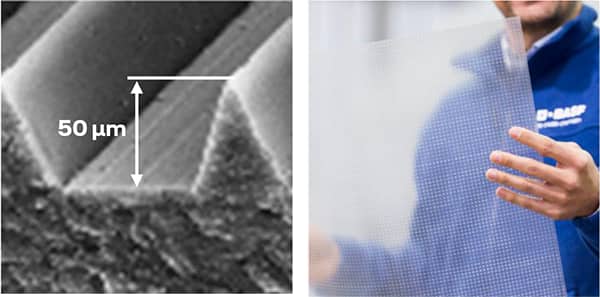
What is AeroSHARK?
AeroSHARK, a joint development by Lufthansa Technik and BASF, is a functional surface film inspired by the drag-reducing structure of sharkskin.
Equipping Aircraft with Winglets
Winglets are specialized aerodynamic devices fitted to the tips of an aircraft's main wings to reduce drag during flight. By installing winglets on our Boeing 767-300ERs - primarily used for long-haul routes - we have improved fuel efficiency by approximately 5%, resulting in an annual reduction of 2,100 tons of CO2 per aircraft. In 2010, the ANA Group became the first Japanese airline to equip a Boeing 767-300ER with winglets, and we have since completed a fleet-wide rollout for all B767-300ER aircraft.
Implementation of Next-Generation Paint Systems
We are adopting an advanced, next-generation paint system that provides superior durability and weather resistance compared to traditional coatings. This system is formulated with low volatile organic compounds and results in a lighter overall aircraft weight, further contributing to our efficiency goals.
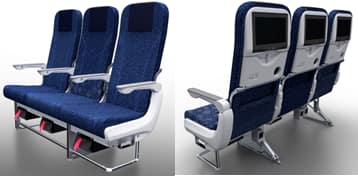
Reducing the Weight of Cabin Seats
In a strategic partnership with Toyota Boshoku Corporation, the ANA Group developed a new standard of seats for domestic routes. By merging our operational expertise as an airline with Toyota Boshoku’s decades of automotive seating craftsmanship, we created a product that balances our technical requirements with a premium passenger experience. These seats align with our philosophy for passengers to have a lasting impression, while achieving a weight reduction of 195 kilograms per aircraft compared to previous models. This innovation alone saves approximately 15 kiloliters of fuel per aircraft annually - all without compromising passenger comfort.
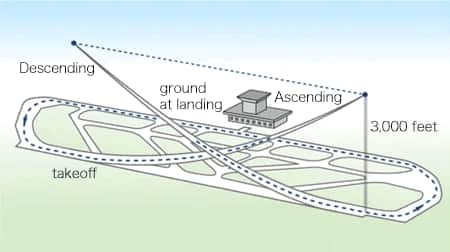
ICAO Landing and Take-Off Cycle
The ICAO Landing and Take-Off (LTO) cycle defines the flight phases from take-off up to an altitude of 3,000 feet, and conversely, from 3,000 feet down to landing. Engine emissions are strictly measured within this specific operational window. The certification process evaluates engine performance based on standardized thrust output settings and specific durations of operation for each phase of the cycle.
| Output Conditions |
Rated Output (%) |
Operating Time (Minutes) |
|---|---|---|
| Take-Off | 100 | 0.7 |
| Ascending | 85 | 2.2 |
| Descending | 30 | 4.0 |
| Ground Taxiing |
7 | 26.0 |
Utilization of Lower Carbon Fuel including SAF
SAF is a key pillar of ANA’s decarbonization roadmap. Our goal is to integrate 10% SAF into our operations by FY2030 and achieve near-total low-carbon fuel usage by FY2050. We are currently working at the national level with government and private partners to accelerate the production and stable supply of Japanese-made SAF.
| 2011 |
|
|---|---|
| 2019 |
|
| 2020 |
|
| 2021 |
|
| 2022 |
|
| 2023 |
|
| 2024 |
|
| 2025 |
|
Click here to learn more about the detail
Use of Offsetting and Emission Trading
To comply with global regulations like CORSIA and ETS, the ANA Group utilizes emissions trading as a supplemental measure. These carbon credits serve as a temporary solution to offset emissions that cannot yet be eliminated through current operational improvements. Our definitive goal remains to reach carbon neutrality by FY2050 through direct emission reductions, eventually phasing out the use of trading schemes entirely.
Utilization of Negative Emissions Technologies (NETs)
The ANA Group believes that Carbon Dioxide Removal (CDR) using these NETs(Negative Emission Technologies)*1 is essential to offset the "residual emissions" that remain even after maximizing direct reductions through measures like introducing SAF, in order to achieve net zero by FY 2050.
As a forward-looking, pioneering action, ANA Group is advancing the utilization of Direct Air Capture (DAC)*2. In 2023, we concluded a procurement agreement with 1PointFive*3 in the United States for CDR credits derived from DAC.
Under our mid-term management plan, we will continue exploring ways to secure effective removal methods while carefully assessing technological maturity and changes in the external environment. Looking ahead, we will pursue both sustainable growth and achieving "Net Zero by FY2050" by optimally combining these innovative carbon removal technologies with the emission reduction measures being implemented across the ANA Group.
- *1.Negative Emission Technologies(NETs): Capturing and sequestering CO2 from the atmosphere
- *2.Direct air capture (DAC): Technology to capture CO2 directly from the atmosphere.
- *3.1PointFive:
1PointFive is committed to reducing global temperature rise by 1.5 °C by 2050 through decarbonization solutions, including Carbon Engineering’s DAC technology, AIR TO FUELS™ technology, and geological storage hubs. AIR TO FUELS™ is a registered trademark of Carbon Engineering Ltd.
Lobbying, Policy Engagement and Industry Advocacy
Governance and Risk Management
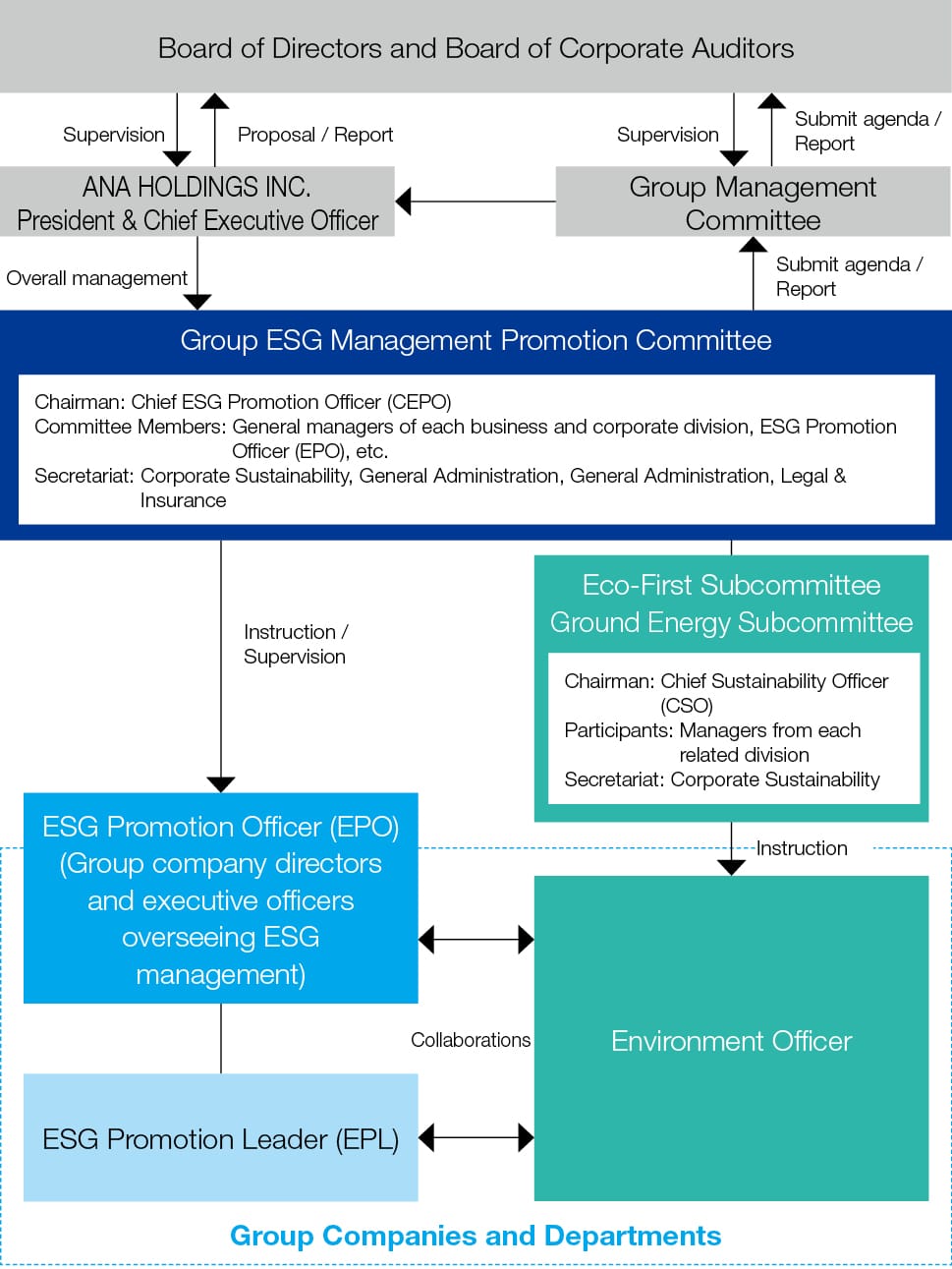
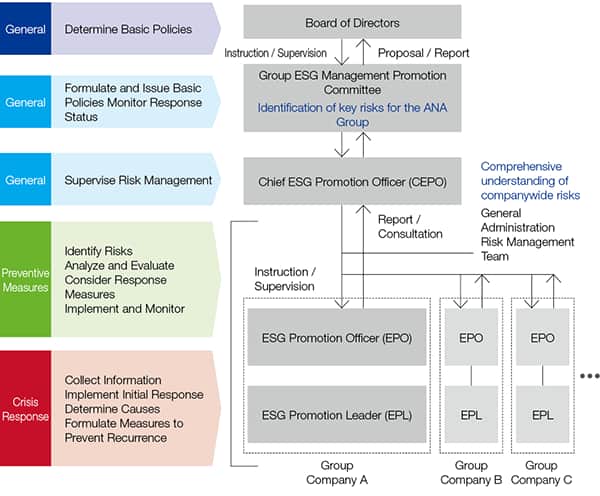
ANA Holdings, Inc. is promoting initiatives to address environmental issues, including climate change, under a structure headed by the President and Representative Director of ANA Holdings, Inc. and chaired by the Chief ESG Officer (CEPO), who has the highest responsibility for promoting ESG management, with directors and executive officers of the Company and Group companies as members of the committee.
The Japanese government has set "2050 carbon neutrality" as a goal in line with the Paris Agreement, and the ANA Group has also set the long-term goal of "2050 net zero" as a response to and reinforcement of climate change risks in line with the Paris Agreement, and the "2030 environmental goal" as a path toward achieving this goal. To achieve these goals, ANA's CEO and other executives participate in government committees, serve on boards of industry associations, and lobby to contribute to climate change policy decisions in line with the Paris Agreement. In addition, the ANA Group monitors the progress of its measures at the Group ESG Management Promotion Meeting, based on the ANA Group Total Risk Management Rules, to assess risks and ensure that industry policy activities align with its policies.
Implementation Structure
Environmental Initiatives with External Organizations (Lobbying in Japan)
Ministry of Economy, Trade and Industry & Ministry of Land, Infrastructure, Transport and Tourism
Participation in Aerospace Industry Subcommittee
Since technological innovation in Japanese aircraft manufacturing is essential to achieving the government's 2050 target, the committee discusses market and carbon neutrality trends and future efforts by aircraft manufacturers that use new energy sources such as hydrogen and electricity, in cooperation with the public and private sectors. ANA Group, as an airline company, has been participating in the committee since June 2023 to promote international joint development by leveraging its knowledge as the launch customer of the Boeing 787.
Please refer to more about committee activities and committee members. Opens in a new window.In the case of an external site,it may or may not meet accessibility guidelines.
Ministry of Economy, Trade and Industry & Ministry of Land, Infrastructure, Transport and Tourism
Participation in the public-private council to promote the use of Sustainable Aviation Fuels (SAF)
In order to utilize SAF, which is considered to be highly effective in reducing CO2 emissions, it is necessary to improve the supply volume, manufacturing costs, etc., which are considered to be an issue. In addition to promoting the development and manufacturing of domestically produced SAF, we are strengthening cooperation between the supply side, such as the wholesaler, and the user side, such as airlines, in order to establish a supply chain in the future. In addition, the public and private sectors are discussing technical and economic issues and solutions. The ANA Group has participated in this committee and promoted discussions based on its experience in introducing SAF. In May 2023, the Agency for Natural Resources and Energy legally set a target supply volume for 2030 as a supply-side regulation, which includes an obligation for wholesalers to replace 10% of fuel used Opens in a new window.In the case of an external site,it may or may not meet accessibility guidelines. by airlines in Japan with SAF by 2030. This will accelerate the introduction of SAF in the airline business. In addition, in January 2024, at the fourth meeting of the Conference, it was decided to provide a total of 336.8 billion yen, including government debt obligations, for a project to support the establishment of an SAF production and supply system. The government will provide public investment support for large-scale SAF production facilities in order to expand the production and supply of SAF in the future, which is expected to establish a system to stably supply SAF at internationally competitive prices.
Please refer to more about committee activities and committee members Opens in a new window.In the case of an external site,it may or may not meet accessibility guidelines..
4th Meeting Secretariat Materials (Japanese only) Opens in a new window.In the case of an external site,it may or may not meet accessibility guidelines..
Participation in the GX League
ANA Holdings, Inc. joined the GX League in March 2024.
With a view to achieving carbon neutrality by 2050 and social change, we will work together with government, academia, and other companies that are taking on the challenge of GX and aiming to achieve sustainable growth in the present and future society.
Participation in Japan Climate Initiative (JCI)
Following the passage of the Paris Agreement in 2015, the Japan Climate Initiative was established in 2018 to strengthen the dissemination of information and exchange of opinions among companies, local governments, NGOs, and others actively working to solve climate change. The ANA Group participates in this initiative and endorses "Japan's participation at the forefront of the world's efforts to decarbonize".
Please refer to more about committee activities and committee members Opens in a new window.In the case of an external site,it may or may not meet accessibility guidelines..
JCI Message Opens in a new window.In the case of an external site,it may or may not meet accessibility guidelines.
The Japan Climate Initiative (JCI) has sent a message to the Japanese government calling for an ambitious 2035 target that is consistent with the 1.5 degree target, and for the Seventh National Energy Strategy to be an enabler of this ambitious level.
In response, ANA Holdings, Inc. endorsed this message.Together with JCI, we will deepen our collaboration with domestic and international non-governmental actors and governments, and contribute to the realization of the 1.5 degree goal.
Japan Transport and Tourism Research Institute (JTTRI)
Participation in Transportation Decarbonization Symposium
The Japan Transport and Tourism Research Institute (JTTRI) is an independent, non-profit organization founded in 1968 as an affiliated organization of the Ministry of Transport (now Ministry of Land, Infrastructure, Transport and Tourism) with the support of government, industry and academia. The forum shares front-line initiatives in fuel strategies for each mode of transportation in Japan, including aviation, shipping, and rail, and discusses challenges and prospects. The ANA Group represents the airline industry and participates in discussions to strengthen cooperation in each mode of transportation and to resolve energy issues for the industry as a whole.
Please refer to more about committee activities and committee members Opens in a new window.In the case of an external site,it may or may not meet accessibility guidelines..
Click here for ANA Group Initiatives. (Japanese only) Opens in a new window.In the case of an external site,it may or may not meet accessibility guidelines.
CARATS (Collaborative Actions for Renovation of Air Traffic Systems)
CARATS is a conference body that was started in 2010 under the leadership of the Japan Civil Aviation Bureau to meet the increasing demand for aviation, as well as to meet the international policies of ICAO, and is an industry-academia-government collaboration to consider new flight operation methods in the future. ANA is participating in the Ministry of Land, Infrastructure, Transport and Tourism's activities to innovate air traffic systems.
ICAO has set targets for 2025 based on air traffic management guidelines, to improve safety and operational efficiency as well as referencing environmentally friendly CO2 emission reduction targets.
CARATS holds discussions on the future of efficient air traffic control systems and actively reflects ANA's opinions on the systems.
Globally, NextGen in the U.S. and SESAR in Europe are making similar efforts, who are working in cooperation with CARATS' activities, with the aim of promoting efficient operations in the future.
We believe that a seamless air traffic control network can be constructed efficiently if various operational relationships share information in a timely manner.
Launch of the 'GOBLEU Project' in collaboration with JAXA
ANA Holdings, Inc. has launched the "GOBLEU Project" with the Japan Aerospace Exploration Agency (JAXA), a national organization, to observe the distribution of greenhouse gas concentrations from an aircraft window (i.e., in space) to accurately determine where greenhouse gases are generated and absorbed, utilizing the AVATAR project conceived by the ANA Group and observation equipment such as JAXA's Greenhouse Gases Observing Satellite "Ibuki". Since 2009, JAXA has been monitoring the increase in global greenhouse gases with the Greenhouse Gases Observing Satellite "IBUKI" (GOSAT). On the other hand, it is possible to obtain more detailed data than with satellites by flying at a lower altitude than with satellites by bringing observation equipment on board an aircraft. Therefore, from 2020, ANA and JAXA are teaming up to conduct the "GOBLEU Project" to observe (remote sensing) the distribution of atmospheric components on the earth's surface from an aircraft. In addition to actual greenhouse gas emissions, the observations can also measure the amount of greenhouse gases absorbed by plants through photosynthesis, and the accumulated results have been reported as one of the new observation methods at the COP28 Global Stocktaking.
This will make it possible to accurately determine where greenhouse gases are generated and absorbed. By observing the composition of the world's atmosphere from space, we aim to reduce greenhouse gases.
Environmental Initiatives with External Organizations (Overseas Lobbying)
ICAO (International Civil Aviation Organization)
ANA has been dispatching staff members to the Delegation of Japan to ICAO in the past, and has continued to send one staff member since 2020.
Additionally, as an advisor to the Ministry of Land, Infrastructure, Transport and Tourism, which is a member of the Committee on Aviation Environmental Protection (CAEP) of ICAO, in which various governments, industry organizations, and academia also participate, ANA participates in the working groups of CORSIA (Carbon Offsetting and Reduction Scheme for International Aviation) and Sustainable Aviation Fuel (SAF) to provide advice and recommendations as an industry representative.
ICAO CAEP HP Opens in a new window.In the case of an external site,it may or may not meet accessibility guidelines.
In addition to ICAO's current CORSIA for international aviation by 2035, the ICAO General Assembly in 2022 agreed to a long-term global aspirational goal (LTAG) for the international aviation sector of net zero emissions by 2050.
LTAG Opens in a new window.In the case of an external site,it may or may not meet accessibility guidelines.
IATA (International Air Transport Association)
ANA's president is currently selected as a member of the Board of Governors (BOG) and its suborganization advisory committees for the environment and cargo.
ANA has been elected as a member of the Sustainability and Environment Advisory Council (SEAC), an environmental advisory committee, for 7 consecutive years. We discuss environmental problems and issues at regular meetings held twice a year and at regularly held teleconferences. We also provide advice to the Board of Directors and other organizations to resolve issues that will likely arise in the airline industry.
ATAG (Air Transport Action Group)
ATAG is a non-profit organization that brings together stakeholders and experts in the air transportation sector value chain to lead the industry toward net zero emissions in air transportation by 2050 (Waypoint 2050). ANA supports the activities of ATAG through IATA, an ATAG member.
To view the "Young aviation professionals on flying net zero" video that ANA helped produce, please click here Opens in a new window.In the case of an external site,it may or may not meet accessibility guidelines..
AAPA (Association of Asia Pacific Airlines)
As a member of the AAPA, an industry group consisting of 18 Asian airlines, ANA participates in the Environment Committee, which is a suborganization committee, and holds regular meetings and teleconferences twice a year to discuss various issues that have an impact on the environment and works to resolve these issues.
Star Alliance
We are a board member of the Star Alliance and a member of the Star Alliance Sustainability VEC where we discuss environmental issues and consult on matters that need addressing as a member of the Alliance.