Business Continuity Management
Basic Philosophy
ANA Group has a Business Continuity Promotion Plan to ensure business continuity with safety as the top priority, even in any crisis situation. This plan is based on the basic principles of "putting human life as the top priority" and "prioritizing each Group company's operations and achieving early recovery". It is intended to establish policies and procedures to respond to situations (staff shortages, company buildings and equipment damage, IT problems) that may occur because of a disaster, regardless of the specific impact of the envisioned threats (natural disasters, infectious diseases, accidents, cyber attacks, etc.), ensure the health and safety of customers, executives and employees, minimize the impact on company management and society, and restore business operation to normal as quickly as possible.
In addition, as part of airport-wide BCP efforts, we aim to ensure business continuity at airport by linking the "A2 (Advance/Airport) - BCP" formulated by airport administrator at each airport based on guidelines set by the Ministry of Land, Infrastructure, Transport and Tourism, with the BCPs formulated by Group companies.
- "A2 (Advance/Airport) - BCP" clarifies the maintenance of airport functionality as a whole, the target timeframe for early recovery, and the division of roles and responsibilities of related organizations. It is formulated at each airport with the aim of ensuring the safety and security of airport users (and stranded people), supporting the surrounding area, and maintaining the aviation network.
ANA Group's Business Continuity Plan
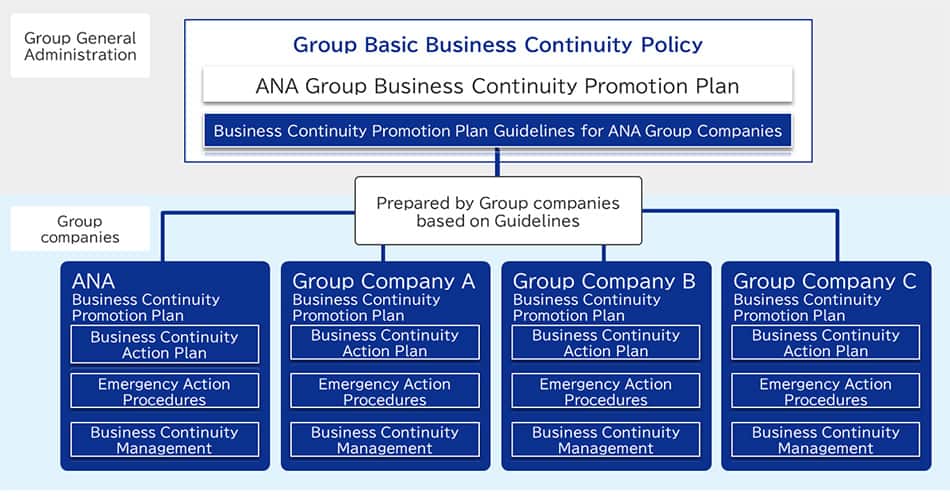
To ensure the safety of customers, executives, employees, and others and minimize the impact on company management and society in the event of a temporary suspension of business activities, we formulated the "ANA Group Basic Business Continuity Policy," an all-hazard type policy not restricted to specific disasters. Each Group company created various manuals adapted for its business characteristics based on the "Business Continuity Promotion Plan guidelines for ANA Group Companies" established by this policy. We are also promoting Business Continuity Management (BCM) to ensure continuous improvement and strive to create an internal system that can respond quickly in the event of an emergency.
Major Initiatives
Response to Large-scale Natural Disasters
The ANA Group is safeguarding its critical operations against large-scale natural disasters to maintain uninterrupted flight operations during power or network outages by deploying emergency generators and backup communication systems at major airports and key hubs, and outfitting critical decision-makers and key personnel with portable emergency power supplies.
In March 2026, ANA was officially designated as a Designated Public Institution by the Prime Minister of Japan in accordance with the “Basic Act on Disaster Management”. Through close cooperation with government agencies, we will further fulfill our responsibilities as a public transportation provider by transporting personnel and emergency supplies for disaster relief.
Business Continuity Plan for Operation Management
In April 2026, the ANA Group decentralized the operational hubs of our operation management functions—the nerve center of flight operations—further fortifying our framework to ensure continuous operations even when facing severe threats such as compound disasters. Through this initiative, we will establish a highly resilient operational foundation capable of withstanding any unpredictable disruptions.
Information Technology Business Continuity Plan (IT-BCP)
Within the ANA Group, numerous systems serve as the vital foundation supporting day-to-day enterprise operations and critical social infrastructure that sustains essential societal functions. Because establishing a robust IT-BCP is indispensable to maintaining safe and stable business operations, we deploy secondary backup data centers in remote locations. Engineered primarily to ensure a rapid transition and business continuity (Disaster Recovery / DR) from the primary data center during catastrophic natural disasters—such as an earthquake directly beneath the Tokyo metropolitan area or a Nankai Trough megaquake—this IT-BCP is formulated considering that its established knowledge can also be adapted and leveraged to manage sudden, non-disaster-related extensive systemic disruptions. Furthermore, the data center architecture incorporates virtualization technologies and IT architectures to drive high-availability redundancy for our major systems, maximize system fault tolerance, and optimize infrastructure efficiency.
To accurately and promptly capture IT risks that could significantly impact business operations, and to respond appropriately during emergencies, the ANA Group executes systematic IT-BCP effectiveness validation tests (simulation exercises) periodically based on catastrophic disaster and system disruption scenarios. Following these exercises, we enforce a strict evaluation and post-event review of the recovery protocols. The identified gaps and lessons learned are formally and reliably integrated back into our physical and digital infrastructure controls, driving a continuous improvement loop that fortifies our operational resilience and ensures the long-term delivery of safe, stable services as a vital public infrastructure provider.
Education and Training
To ensure that all ANA Group employees understand ordinary preparedness and emergency response protocols in case, we conduct annual disaster preparedness e-learning. In addition, we carry out simulation drills and safety confirmation response training to enable a rapid initial response to the occurrences of actual disasters.
Furthermore, we conduct practical tabletop exercises simulating disaster scenarios for all BCP personnel across the ANA Group.
Preparation of Emergency Stockpiles
To sustain business operations for a certain period in case of large-scale disasters, and to comply with requirements from local government to mitigate a rush of commuters returning home at the same time, the ANA Group has established the "ANA Group Storage guidelines for disasters" in accordance with standards set by national and municipal governments, and is preparing emergency stockpiles at each business location.
Response to Novel Influenza and Other Infectious Diseases
The ANA Group has established the “ANA Group Novel Influenza Response Manual” to fulfill its social responsibility—to protect the lives and health of the Japanese people and minimize the impact on daily life and the national economy—in the event of an outbreak of infectious diseases such as Severe Acute Respiratory Syndrome (SARS), novel influenza, Middle East Respiratory Syndrome (MERS), and the novel coronavirus.
Furthermore, ANA as a Designated Public Institution under the Act on Special Measures Concerning Novel Influenza, we are required to coordinate and cooperate with the national government, local governments, and other relevant parties to swiftly and appropriately implement measures aimed at delaying the entry and spread of infectious diseases into Japan as much as possible. To carry out these duties, ANA have established the “Operational Plans for the Implementation of Countermeasures Against a Novel Influenza”.
In the event of an infectious disease outbreak that has a significant impact on society, based on these manuals and operational plans, we will establish specific response systems—including information-gathering mechanisms prior to the spread of infection, the establishment of a response headquarters tailored to the situation, and the deployment of response supplies to overseas offices—while coordinating with relevant ministries and agencies, such as the Ministry of Land, Infrastructure, Transport and Tourism and the Ministry of Health, Labor and Welfare, to ensure the continuity of our air transport operations to the greatest extent possible.