1. Safety Risk Management
Safety Risk Management Process
At the ANA Group, risk management for safety incidents and nearmiss reports is implemented through the following process by designated 'Safety Risk Assessors' who have completed prescribed training. This framework applies not only to aircraft 'operations' but also to the fields of 'customers' and 'employees (workers).'
-
Flight Operations
Preventing accidents / serious incidents
-
Customers
Protecting our customers from physical and life-threatening danger from departure until arrival
-
Employees (Workers)
Protecting ANA Group employees from danger



Gathering Safety Information and FactFinding
By gathering safety data and near-miss information from internal and external sources, we analyze the exact facts of each situation. We then verify the presence and effectiveness of our safety "barriers"—the layers of protection designed to block risks and prevent incidents before they occur.
Hazard Identification
Through detailed investigations and data analysis, we identify potential hazards that might threaten safety.
Event Classification
We assess the actual consequences of an event, its proximity to a serious accident, and the effectiveness of our safety barriers in maintaining a solid margin of safety
Safety Risk Assessment
We assess safety risk by assuming the maximum credible consequence if an event scales up. To determine the overall risk level, we evaluate this from two perspectives: the severity of its potential impact and the likelihood of its occurrence.
At the ANA Group, we utilize two different approaches for risk assessment. Highconsequence events—including turbulence, runway incursions, and aircraft fires—are designated as "Key Safety Issues" and assessed through the ARMS*1 methodology. Other safety-related events are evaluated using a matrix that combines "severity of impact" and "likelihood of occurrence" to assess risk.
- *1.ARMS (Aviation Risk Management Solutions): An objectivity-focused risk assessment method based on the "Bow-tie model" (scenarios) adopted by international aviation authorities and airlines.
Two Risk Assessment Method
- STOP
- Critical risk level requiring immediate executive decisions and corrective actions
- IMPROVE
- High risk level requiring prompt executive decisions and mitigation actions
- SECURE
- Acceptable risk level that requires monitoring under established management standards
- MONITOR
- Risk level that can be managed within routine daily operations
- ACCEPT
- Risk level that is well within the acceptable range
- LevelD
- Requires management to give it first priority over other issues and immediately take corrective actions to eliminate the risk, while considering the suspension or outage of similar operations and services (reduce risk under same management system as Risk Level C)
- LevelC
- Requires reporting to the Safety Promotion Committee, with the Safety Promotion Center to act as the administrative body for action-taking departments under management’s decision, and corrective actions to be taken as quickly as possible to reduce the risk level to Level B or lower
- LevelB
- Requires collaboration between the administrative organizations and the frontlines, led by the special functions, to take actions to systematically eliminate the risk and to make improvements to reduce the risk level to Level A
- LevelA
- Requires the special functions together with the administrative organizations or frontlines to take action to prevent recurrence by regularly sending out reminders, sharing information and accumulating knowledge
Root Cause Analysis and Mitigation
We analyze the direct causes of un-safety events and why safety barriers failed, looking at factors such as environment, equipment, procedures, and human elements. Based on the findings and the risk level, we develop and implement preventive measures.
| Risk Assessment Using the ARMS Method | Risk Assessment Using Severity and Likelihood | Actions Based on Safety Risk Levels |
|---|---|---|
| STOP | Level D | Management must prioritize risk reduction measures, which may include suspending relevant flights or services until initial countermeasures are completed. |
| IMPROVE | Level C | The issue must be reported to the Corporate Safety Committee. Under the guidance of executive management, the Corporate Safety Center will oversee the response while operational departments implement prompt countermeasures to reduce the risk level. |
| SECURE | Level B | Centered on each specialized function, management and the frontline must collaborate to implement planned risk-elimination measures and maintain risks at a low level. |
| MONITOR | Level A | Centered on each specialized function, management or the frontline must raise awareness, share information, and accumulate knowledge daily to implement recurrence prevention measures. |
| ACCEPT | No special measures are required. |
Standard-Based Monitoring
After implementing measures, we continuously monitor them to verify their effectiveness according to management standards. The safety insights gained are shared and accumulated organization-wide to prevent similar events and further enhance safety.
Change Management
Air transportation requires adherence to safety in a constantly changing environment.
Bowtie Model
The Bowtie Model is a risk assessment methodology with a diagram that can analyze and demonstrate cause-and-effect relationships in high-risk scenarios and has been adopted by leading airlines. It is used to visually understand risks and to take more systematic and effective countermeasures by evaluating the existence and effectiveness of protective barriers that should exist between the "threat* (cause)" of an event and the "unsafe event" that can be assumed from that event, and the "maximum credible consequence" that that event can lead to. ANA uses it for our risk management to ensure efficient and effective safety management.
- *2.Threats: those that may act on the hazard and be the direct cause that creates an unsafe event.
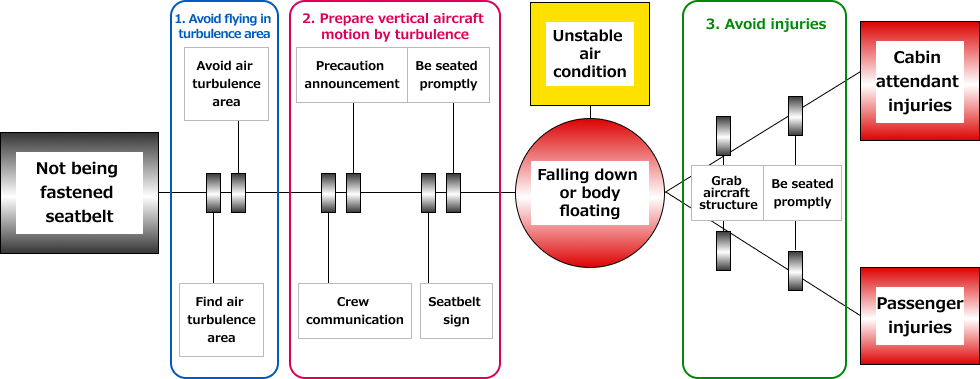
Fig. An image of Bowtie model related to an accident caused by turbulence*³
- *3.The above bowtie model is only an example; in reality, various measures are taken in addition to the above barriers (countermeasures)
2. Recent Safety Risk Management Initiatives
2-1 Countermeasures against accidents caused by air turbulence
In recent years, changes in the weather environment have increased the risk of injury to passengers and Cabin attendants due to air turbulence worldwide.
ANA Group is working to prevent injuries to passengers and cabin attendants caused by air turbulence from the three perspectives; "avoid flying in the turbulence area", "prepare vertical aircraft motion by turbulence", and "avoid injuries".
1)Avoid flying in the turbulence area
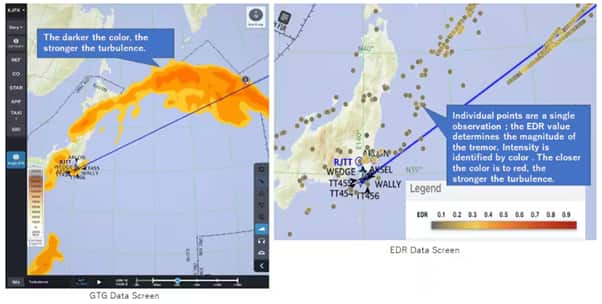
In addition to conventional weather analysis, information from other aircraft in flight, and from air traffic control, we have also introduced Jeppesen's GTG (Graphical Turbulence Guidance) and EDR (Eddy Dissipation Rate) under contract with IATA, tools that enable turbulence prediction and appropriate route selection.These tools allow flight crews, dispatchers and others to check highly accurate predicted and actual data of turbulence via their tablets. Also, flight crews can update turbulence information during flight. ANA is the first airline in Northeast Asia to contract with IATA to implement EDR, and the introduction of EDR is expected to improve the safety and comfort of its operations.
2)Prepare vertical aircraft motion by turbulence
Communications between flight crews and cabin attendants is one of the most important factors in order to prevent injuries due to turbulence. Flight crews will determine the timing to turn on the seat belt sign taking into consideration ont only the cockpit experience but also the vertical motion in the cabin. The cabin attendants will alert passengers as soon as possible when the seat belt sign is turned on, and even when the sign is turned off, if they determine that passengers are in danger due to aircraft motion due to turbulence, they will take safety measures such as instructing passengers to fasten their seat belts and report the cabin situation to the captain.
3)Avoid injuries
In order to inform passengers of the actions they should take when encountering vertical aircraft motion due to turbulence, raise their awareness of prevention, and encourage them to take their own safe actions, a safety video is shown in the aircraft to alert passengers to the vertical aircraft motion due to turbulence.
Also, the highest priority of cabin attendants during encountering the unexpected and sudden vertical aircraft motion due to turbulence is to secure their safety on the spots. They check in advance where they can hold on, such as a galley handle or an armrest, in order to minimize body floating due to turbulence and protect themselves. In addition, the new employees of cabin attendants are trained at a motion mockup, which can simulate vertical and horizontal aircraft motions, to experience these motions so that they can take immediate action to protect themselves during flight.


2-2 Alcohol Countermeasures
Alcohol consumption by executive and non-executive employees who perform duties related to air transport safety will be deemed a hazard to flight operations, and therefore alcohol countermeasures will be implemented as part of the Safety Management System (SMS) from the standpoint of preventing accidents and incidents.
1)The alcohol countermeasures system
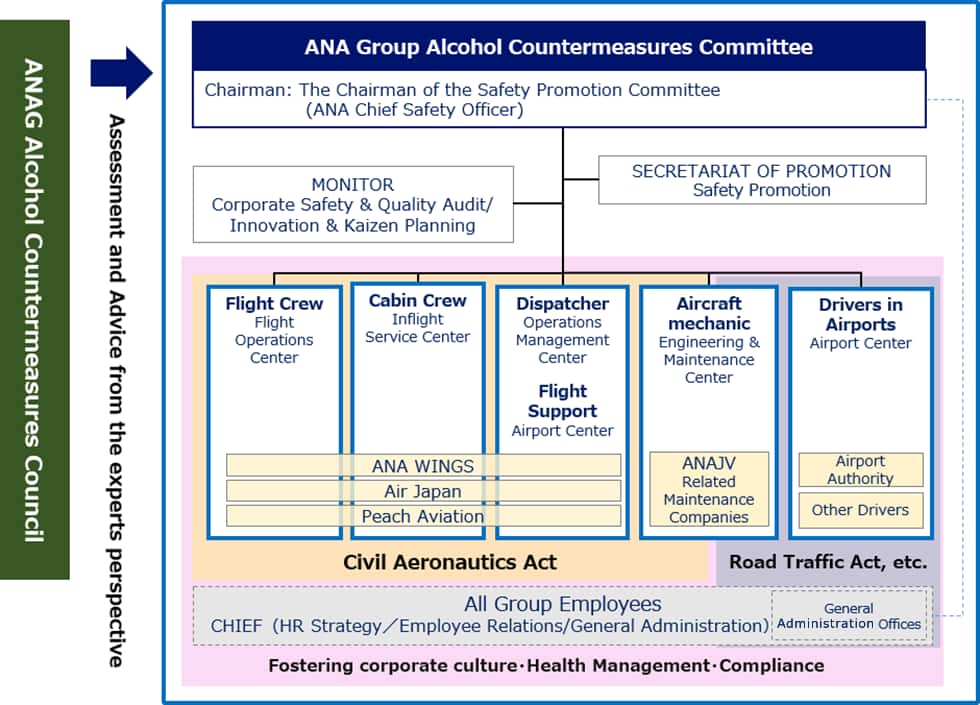
ANA Group has established the ANA Group Alcohol Countermeasures Committee (Chairman: ANA Chief Safety Officer / Secretariat: Corporate Safety at ANA) to determine important matters regarding alcohol countermeasures at the management level. The committee aims to eradicate unsafe events caused by alcohol consumption and improve the health of ANA Group employees.
Furthermore, we have established the ANA Group Alcohol Countermeasures Council to ensure transparency with and the continuous improvement of ANA Group alcohol countermeasures by having external experts evaluate and provide advice on all countermeasures.
2) Main initiatives
Establishment of a reliable and rigorous alcohol testing system
The Annexes of Operations Policy Manual and the Approved Organization Exposition stipulate that flight crews, cabin attendants, aircraft mechanics and other operational personnel are not allowed to work in a state affected by alcohol. This is ensured by conducting alcohol tests using alcohol detectors in an environment where wrongful acts cannot be committed, such as having a third party witness the tests.The results of all alcohol tests are reported to the respective management departments, regardless of the outcome, through a third party or the system. They are recorded and managed strictly.
Establishing responsible drinking habits among all employees
ANA Group is committed to the "TEKKIN initiative@012", which involves all employees. This initiative aims to establish a habit of zero drinks for those who cannot drink or choose not to, one drink for those who are sensitive to alcohol, and two drinks as the recommended daily limit. Additionally, it promotes designating two days a week as rest days. We are establishing a workplace environment across the entire organization where every employee can deepen their correct understanding of alcohol-related issues. This environment is built on autonomous self-management and mutual trust, enabling everyone to feel rest assured and develop responsible drinking habits. Furthermore, Every November is designated as "ANA Group Responsible Drinking Promotion Month" to reinforce this message.
2-3 Fatigue risk management for crew members
The fatigue experienced by flight crews and cabin attendants poses a hazard to flight operations. Fatigue risk management will therefore be managed as an aspect of the safety management system to proactively prevent accidents and incidents.
1) Fatigue risk management system (example of flight crews)
Fatigue Safety Action Group (F-SAG), which specializes in analyzing the fatigue risk among flight crews, has been established. This group is responsible for developing and implementing risk management and educational activities, aimed at preventing the occurrence and recurrence of fatigue-related unsafe conditions.
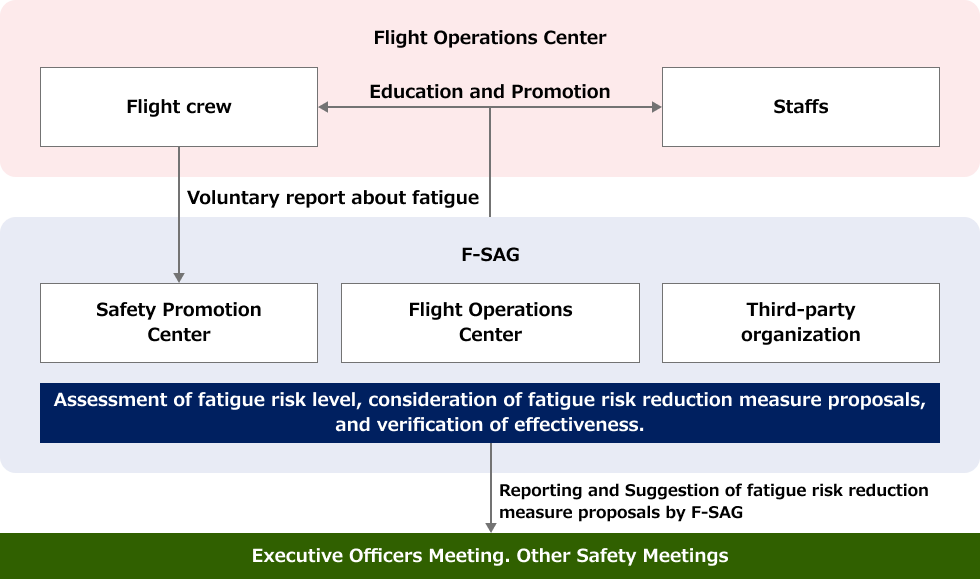
2) Main initiatives
Flight crews, cabin attendants, and other members involved in fatigue risk management must keep in mind that they each have responsibilities regarding fatigue risk management and strive to mitigate the fatigue risk. To identify fatigue hazards, information provided by flight crews and cabin attendants is important and their active provision of information is encouraged. Collected information is analyzed and countermeasures are implemented if needed. After implementing countermeasures, their validities are evaluated and it is confirmed that the fatigue risk has been mitigated. We are performing education in order to operate fatigue risk management appropriately and working on promoting and establishing fatigue risk management.
3. Other Safety-related Initiatives
3-1 ANA Peer Support Program
ANA conducts Peer Support Program (ANA Peer Support Program) for improving the mental health of flight crews and setting up an environment where they can live and work in a healthy and well-being environment. ANA Peer Support Program is a program in which trained flight crews (peer supporters) work closely with colleagues who are suffering from anxiety or worries, and actively listen to their concerns to alleviate or eliminate them.
3-2 Flight Crew Mental Health Assistance Program
The mental health screening for flight crews is checked annually via interviews with psychiatrists during periodic aviation medical examinations.
Flight crews with a mental health issue are permitted to return to duty after completing the procedures described in the Annexes of Operations Policy Manual. In addition, stress checks are conducted annually for all employees, including flight crews, to promote their health.
3-3 Drug Screening
The following items are prohibited for flight crews in accordance with company regulations.
- In principle, the use of anesthetics or other drugs (including psychoactive substances) that remain in effect until the duty of the flight.
- The use of drugs for purposes other than medical treatment based on a doctor's instruction.
- Using drugs for medical purposes before the completion of the medical treatment.
The aviation medical examination includes items related to drugs, and the doctor must certify that the flight crew is not addicted to drugs.
3-4. Food Safety and Security
To ensure safety and high quality of in-flight meals, ANA incorporates a quality management system called the ACQP (ANA CATERING QUALITY PROGRAM), consisting of the following 3 aspects.
- Food safety on board and in lounges
- Premium taste quality
- Safe, prompt, and accurate loading and unloading of in-flight service items and their management
In particular, with regard to food safety, in addition to regular on-site hygiene audits conducted by certified auditors at contract catering companies in Japan and around the world, third-party audits are conducted to ensure more objective evaluations of the catering companies.