Initiatives in all Non-Aircraft Flight Operations
ANA Group's Initiatives to Reduce CO2 Emissions
Reducing Energy Consumption
Based on the Energy Conservation Law, the ANA Group is working to reduce energy consumption at all group facilities using its own energy management standards. ANA and ANA Foods Co., Ltd., which are "specified businesses" under the Energy Conservation Law, achieved a 1% or more reduction in their five-year average energy intensity in their fiscal 2023 results (2024 report), and were certified as "Excellent Energy Conservation Businesses (S Class)" under the Energy Conservation Act classification system of the Ministry of Economy, Trade and Industry.
ANA has achieved S Class for 10 consecutive years since the classification system was established.
In addition to deepening energy conservation measures at each business location, we will also introduce HVs (hybrid vehicles), EVs (electric vehicles), FCVs (fuel cell vehicles), and renewable diesel (RD) for airport vehicles, and gradually update our facilities and equipment to energy-saving equipment.
Utilization of renewable energy
The ANA Group is promoting the use of renewable energy.
The ANA Group's General Training Center ANA Blue Base (ABB), ANA Tonomachi Business Center, and ANA Telemart's Nagasaki Branch Call Center all use solar power by installing solar panels. We are also promoting the use of renewable energy throughout the ANA Group, including our own facilities in Osaka and Kyushu.
New initiatives to promote renewable energy
ANA Holdings, Inc. will use "green electricity (effectively renewable energy) "provided by Mitsui Fudosan Co., Ltd. for part of the electricity used at its Shiodome office, contributing to reducing CO2 emissions. This "green electricity" refers to practically renewable energy with environmental value derived from residential solar power generation that has expired the feed-in tariff (FIT) power purchase period (post-FIT).
Mitsui Fudosan Co., Ltd. has concluded "Comprehensive Agreement related to Greening Power Consumption" with TEPCO Energy Partner, enabling the stable supply of "green electricity" to tenant companies. We will support the initiative and utilize Mitsui Fudosan Co., Ltd.'s "Green Energy Supply Service*1".
The annual usage is equivalent to approximately 50% of the ANA Group Shiodome office electricity consumption.
- Green Energy Supply Service:
Mitsui Fudosan Co., Ltd.'s independently developed service that provides electricity used in office buildings, etc. as effectively renewable energy certified by non-fossil certificates, and is characterized by the flexibility to design the introduction ratio, etc. in compliance with RE100, etc.
ANA Group Energy Savings
ANA Group has set a goal of reducing CO2 emissions generated outside of aircraft operations to zero by fiscal year 2050, and is working to reduce energy consumption at Group-owned and leased facilities. As a representative energy-saving facility, ANA Blue Base (ABB) is promoting initiatives involving all ABB tenants under the theme of “fostering a culture of energy conservation” by reducing and visualizing energy consumption and disseminating information using a variety of content.
We are also promoting initiatives to reduce vehicle fuel consumption.
Resource Recycling 3R Activities
The ANA Group promotes the 3R initiatives to reduce, reuse, and recycle+ R (Renewable) and is working to reduce the waste rate of resources, particularly plastics and paper.
Reducing the use of plastic
We are promoting the use of environmentally friendly materials for plastic products used in airport lounges and onboard flights. We have changed the containers for main dishes on international flights to plant-derived materials, straws to paper, and cutlery and muddlers to wooden ones, reducing the amount of disposable plastic used on board by approximately 40%, or 475 tons per year (in fiscal 2023).
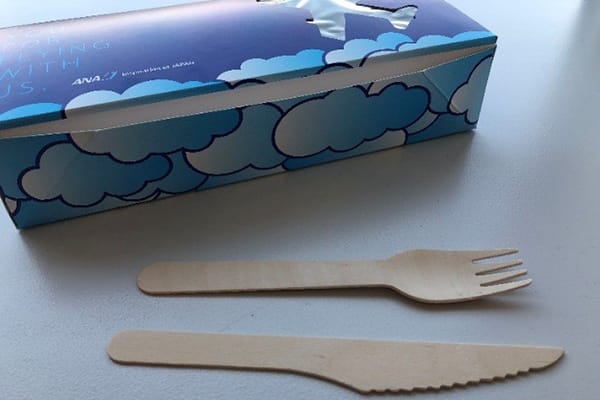
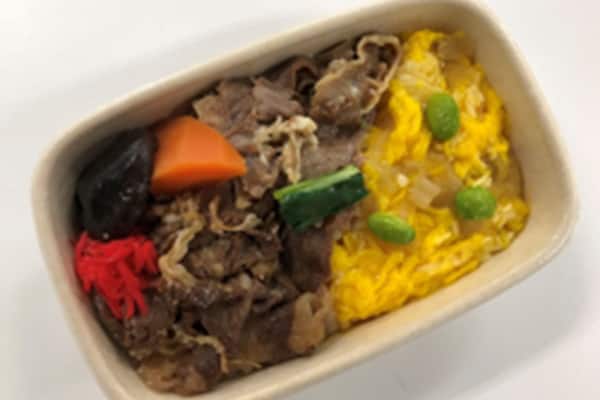
We are also encouraging the recycling of vinyl used for cargo packaging, not only to reduce the amount used but also to promote the 3Rs.
ANA and Chubu Centrair International Airport Co., Ltd. to develop a resource recycling scheme
ANA and Central Japan International Airport have jointly established an airport resource recycling scheme by collecting used plastic film for air cargo and recycling it into plastic products for use at Central Japan International Airport. As a result, approximately 20 tons of plastic waste per year is no longer disposed of, and a portion of this waste is recycled within the airport.
This approach contributes not only to the circular economy but also to decarbonization. In recognition of our technology and activities, we received the “2025 Environmental Award in Aichi prefecture”.
Reducing the use of paper
In May 2023, we began renovations of security checkpoints and boarding gate turnstiles for domestic flights to phase out paperbased security certificates, boarding information. We are also reducing the use of paper resources through digital publishing and other services for passengers to view magazines and newspapers on their own mobile devices.
Joint Development of the World's First New Material "Appurun"
The brainchild of a flight attendant!
Upcycling the in-flight magazine “TSUBASA -GLOBAL WINGS” as a raw material
ANA and BECS have jointly developed “Appurun,” an upcycled paper material that can be molded as flexibly as plastic, from the in-flight magazine "Tsubasa no Okoku. The raw material for “Appurun” is ANA's in-flight magazine “TSUBASA -GLOBAL WINGS,” which is published monthly and has traveled all over the world. The finished product has a smooth, plastic-like texture to the touch, making it the world's first material of its kind.
After use, the material is highly recyclable as it adapts to the existing recycling flow of recovered paper collection, and has great potential to reduce the amount of paper waste as well as the use of plastic as an alternative material to disposable plastic products!
Details
Reduce
Reuse
| Cabin |
|
|---|---|
| Airport Facilities |
|
| Company Facilities |
|
Recycle
| Cabin |
|
|---|---|
| Cargo |
|
| Airport Facilities |
|
Renewable
| Cabin |
|
|---|---|
| Cargo | |
| Airport Facilities |
Reducing Food loss and Food waste
ANA Catering Service, Inc., a food manufacturing company, and ANA Foods, Inc., a food sales company, are working to improve the recycling rate of food ingredients generated in the processing process in compliance with the Food Recycling Law.Meanwhile, in order to reduce in-flight food waste, ANA monitors the waste rate on domestic (premium class) and international (first class and business class) flights, and reviews the number of in-flight meals carried. On international first and business class flights, we have introduced an AI-based meal pre-booking service to avoid situations where meal requests cannot be met on board, and at the same time, we have eliminated excess food on board, thereby improving passenger satisfaction and reducing food waste.
Food Loss Initiatives
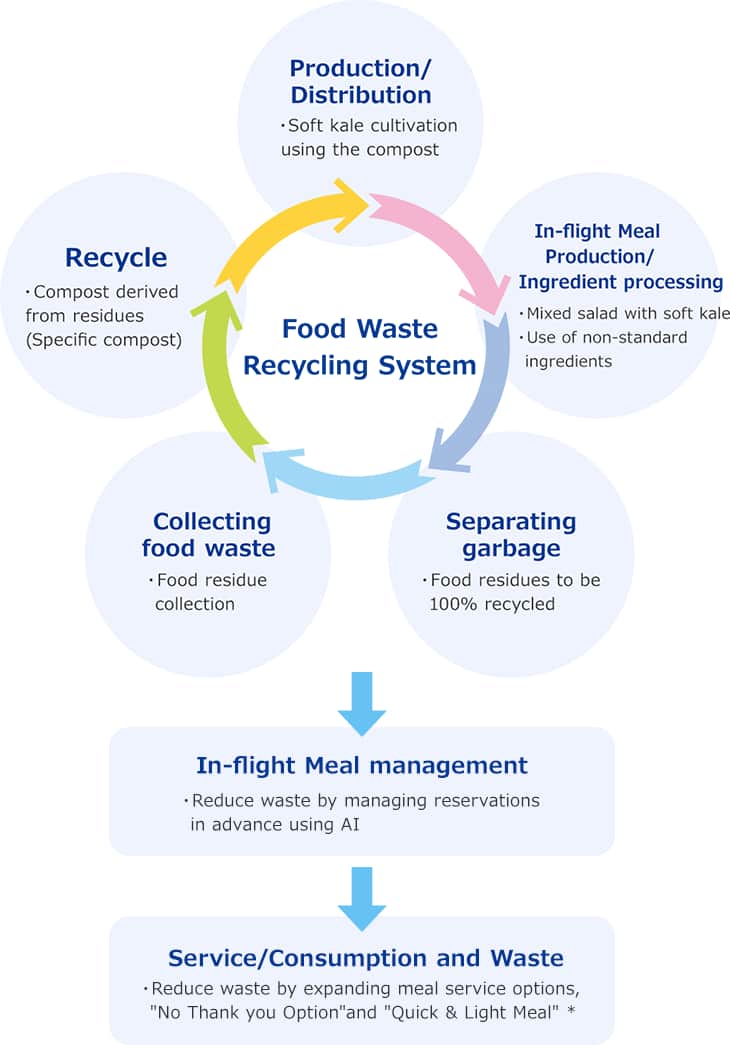
As an initiative against food loss, we utilize food waste generated in cooking. ANA Catering Service Co., Ltd. (ANAC), which manufactures in-flight meals for ANA, recycles 100% of food waste from the cooking process into compost and animal feed. As a recycling initiative using this waste effectively in-house, soft kale grown using compost derived from cooking food waste generated at ANAC's Narita factory is provided in salads served in economy class on some international flights from March 2022.
This recycling system was certified by the Ministry of Agriculture, Forestry and Fisheries as "Recycle Loop Certification" in December 2022.
This is the first time in Japan for an airline-operated catering company.
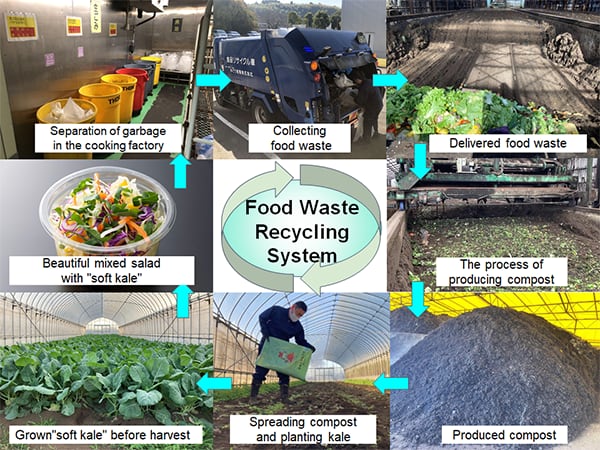
Food Sustainability in Life Cycle
The ANA Group has established a "food recycling system" to achieve effective use of food materials, and manages food waste throughout the life cycle of food materials, from ingredients to the provision of in-flight meals to customers.
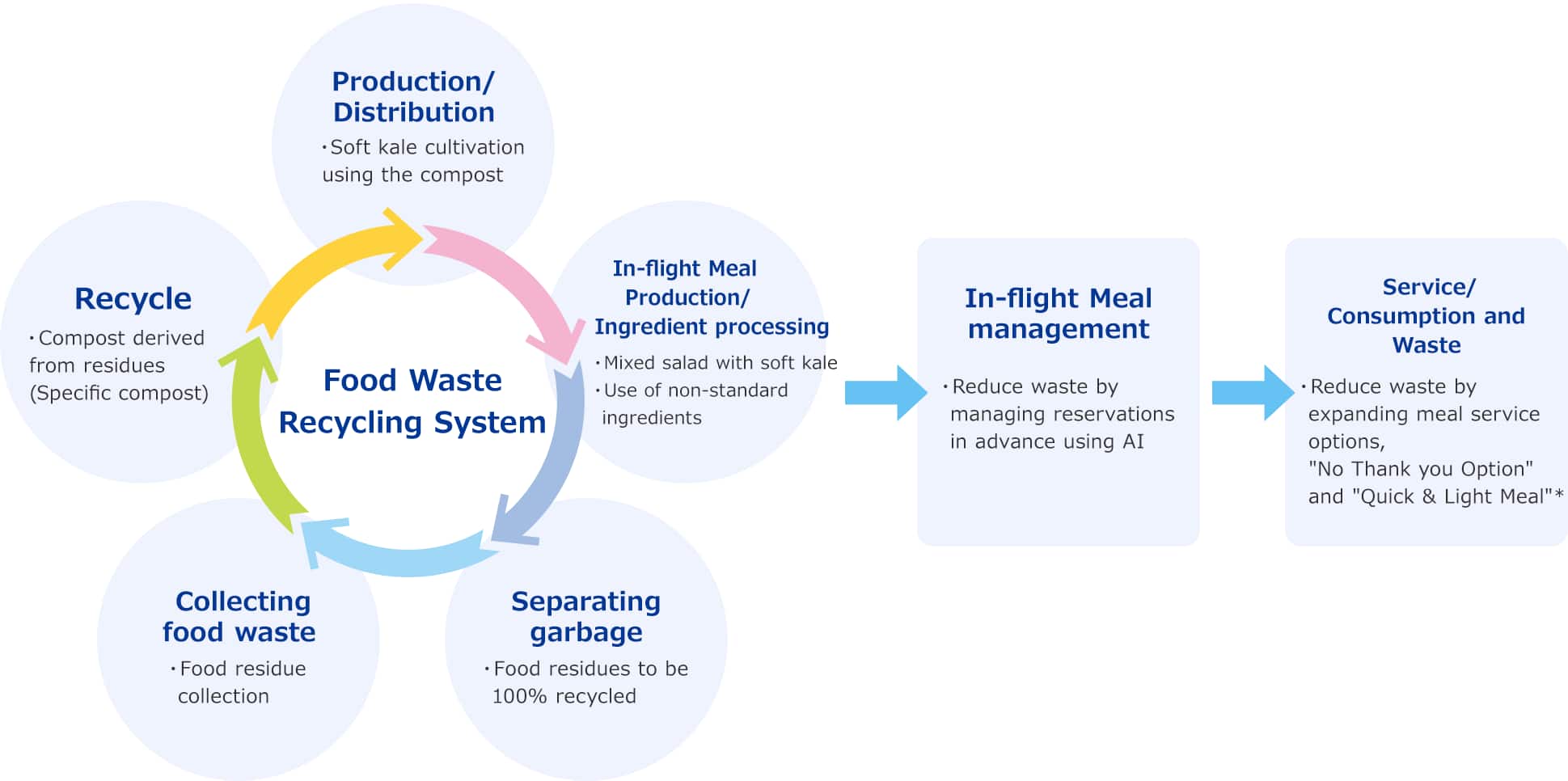
Japan's Recycling Laws: Our Commitment to Resource Efficiency
At ANA, we actively comply with Japan's key recycling legislation, contributing to a more resource-efficient society.
The Container and Packaging Recycling Law,
this law aims to reduce waste by promoting the effective recycling of containers and packaging. It outlines distinct roles for all stakeholders: consumers are responsible for separation and discharge, municipalities for collection, and businesses for recycling. The Japan Containers and Packaging Recycling Association is entrusted with managing the recycling process. This law is overseen by a joint jurisdiction of several ministries, including the Ministry of Environment and the Ministry of Economy, Trade and Industry.
The Food Recycling Law Enacted in 2000,
this law promotes the recycling of food resources. It mandates producers and sellers to reduce and recycle food waste, such as material waste, unsold food, and leftovers from the food manufacturing process. To systematically advance food recycling, the Ministry of Agriculture, Forestry and Fisheries and the Ministry of the Environment set industry-specific targets (e.g., for food manufacturing, retail, wholesale, and restaurant sectors). The ANA Group fully complies with the Food Recycling Law, annually reporting our food waste amounts by ingredient and the quantities recycled.