Major Initiatives
Based on the fiscal 2025 re-assessment and recommendations from external experts, the ANA Group has updated its "Priority Human Rights Themes" to the following four themes from fiscal 2026.
The details and specific initiatives for each theme are outlined below.
- Theme 1: Addressing Human Rights Issues Related to Foreign Workers
- Theme 2: Addressing Human Rights Issues in the Supply Chain
- Theme 3: Prevention of the Use of Airplanes in Human Trafficking
- Theme 4: Respect for Human Rights in the Utilization of AI
- Examples of Responses to Other Human Rights Issues
- Training our Staff
Priority Human Rights Themes
Theme 1: Addressing Human Rights Issues Related to Foreign Workers
- Why We Consider This Theme To Be Important
Workers of a wide range of nationalities support the ANA Group's business activities. Recent media reports have uncovered various human rights abuses of foreign technical interns and students from abroad in Japan. Since many foreign workers work in the ANA Group's supply chain, we believe that there are potential human rights risks, and since 2016 we have made this a priority humanrights theme and have taken various measures, focusing mainly on group companies and their partner firms such as contractors. - Relevant Stakeholders
- ANA Group employees
- Employees of partner firms (contractors etc.) in Japan and overseas
- Foreign workers and other individuals employed at the above firms, etc.
- Activities
The ANA Group has built a system to grasp the actual employment status of foreign workers and make improvements in reference to the opinions of the workers themselves. It is composed of the following three steps:
STEP 1: Determination of employment conditions
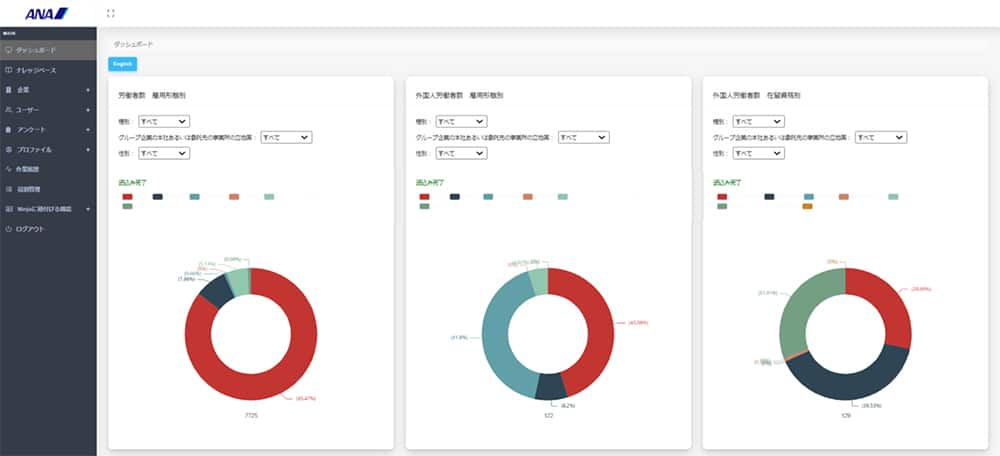
By making effective use of the Global Supply Chain Worker Data Management System, we have been collecting data, such as the following, from ANA Group companies as well as from the Group’s major partner companies and suppliers in order to identify the actual employment status of foreign workers (e.g., number of persons, nationality, and status of residence). Also, to obtain data about the business and human rights-related initiatives implemented by these companies, we have been asking them to respond to the surveys on compliance with the ANA Group’s Basic Procurement Policy and the Supplier Code of Conduct and on measures for human rights and environmental issues.
(The employment of a total of 7,151 foreign workers was confirmed as of FY2025 as a result of conducting a survey on 40 ANA Group companies and 153 ANA Group contractors and suppliers.)
STEP 2: Direct questionnaire surveys of foreign workers
Based on the results of the employment conditions survey, we conduct a questionnaire survey directly targeting specified skilled workers and technical interns, who are considered to be among the foreign workers who are at high risk of experiencing human rights violations, to collect their opinions. The questionnaire form is composed of about 30 questions based on the Dhaka Principles, which are international standards, and is conducted online in 11 languages as an anonymous survey. The results are utilized for the analysis of human rights-related risks.
STEP 3: Face-to-face interviews of foreign workers
We directly interview foreign workers who have been deemed as potentially at risk of experiencing human rights violations and check their living spaces, receiving support from the third-party organization CRT to ensure the objectivity and neutrality of the interviews.
We follow these three steps each fiscal year, and when an issue is identified we inform the relevant Group companies, major partner companies and suppliers accordingly so that we can make improvements together.
We will continue to conduct regular surveys into the employment conditions of migrant workers in our supply chain, and examine safe and reliable channels for recruiting migrant workers at the ANA Group and throughout our supply chain.
- Human Rights Due Diligence and Risk Mitigation Performance
The ANA Group conducts regular human rights risk assessments across our operations and contractors/ suppliers to identify potential or actual human rights impacts.
For all cases where salient risks are identified, we immediately formulate and implement specific mitigation plans to ensure continuous tracking and remediation.
Status of Human Rights Mitigation Plans
| FY2023 | FY2024 | FY2025(p) | |
|---|---|---|---|
| Number of sites / suppliers with human rights mitigation plans formulated and implemented | 2 | 5 | 5 |
| Ratio of identified sites / suppliers with human rights mitigation plans | 100% | 100% | 100% |
- (p): Provisional data subject to change upon final review.
Theme 2: Addressing Human Rights Issues in the Supply Chain
- Why We Consider This Theme To Be Important
With advancing globalization in recent years, corporate supply chains are also expanding throughout the world. At the same time, to solve problems such as forced labor and child labor that are prevalent around the world, not only government agencies but also corporate entities must take responsibility for their entire supply chain and exercise appropriate control. In fact, there are many cases where the brand value of a client has been significantly damaged due to problems discovered at a supplier. Legislation to have companies check and report human rights and environmental issues in the supply chain is making progress in each country, and we believe that failure to address these issues will be a major management risk.
A single airplane consists of approximately three million parts, and the supply chain for these is both complex and extensive. Although the core business of the ANA Group is aviation, our mission is also to provide a safe, secure, and comfortable in-flight environment for our passengers. Therefore, we believe that building a highly transparent and traceable supply chain not only for aircraft parts but also for in-flight meals and in-flight goods is essential to fulfilling our responsibility to our customers. - Relevant Stakeholders
- ANA Group companies
- Partner firms and contractors
- Business partners
- Workers employed above, etc.
- Activities
Supply Chain Management for In-flight Meals Provided by ANA CATERING SERVICE CO.,LTD. (ANAC)
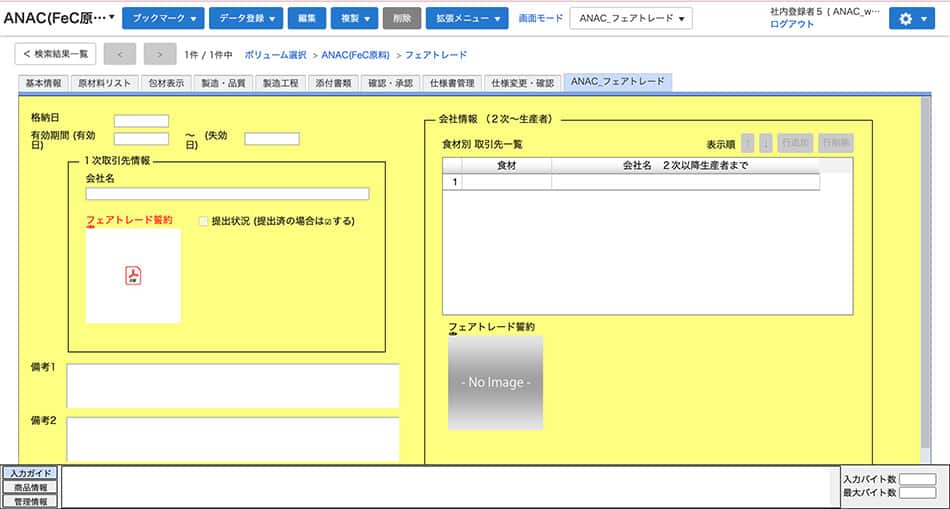
As our basic platform for managing our suppliers, we use eBASE, a product information database. The database software supports the construction, integrated management, and utilization of product and content information within the company as well as the exchange of product information between companies. Approximately 95% of ANAC's tier 1 suppliers have introduced this software. Using eBASE, the ANA Group has obtained signed pledges of the ANA Group Supplier Code of Conduct from 146 tier 1 suppliers and six tier 2 suppliers.
For high-risk and medium-risk suppliers, every year we confirm the employment status of foreign workers through the Survey of the Employment Status of Foreign Workers conducted by ANA HOLDINGS INC. Furthermore, to build good relationships with suppliers, we regularly hold "ANAC Suppliers Gatherings", which serve as a forum for sharing information.
For high-risk suppliers, in addition to regular hygiene audits, ANAC employees make direct visits every year to conduct checks in accordance with the ANA Supplier Code of Conduct. In addition, we make efforts to determine the views and opinions of workers by providing information about ourgrievance mechanism "Ninja".
Theme 3: Prevention of the Use of Airplanes in Human Trafficking
- Why We Consider This Theme To Be Important
With flights to cities all over the world, the ANA Group is a global airline group connecting Japan and the world.
However, there is a risk that services provided by airlines like ours could inadvertently be used by third parties to violate human rights, and one typical example of this is human trafficking. Human trafficking is said to be the fastest growing crime in the world, and we believe it is our responsibility to make efforts to prevent human trafficking.
The issue of human trafficking was raised at the IATA’s annual general meeting in Cancun, Mexico in June 2017. Furthermore, at an annual review with human rights experts in September 2017, they recommended that the group address the issue of preventing human trafficking as one of our priority human rights themes. The ANA Group is working with other airlines, industry organizations, relevant ministries and agencies, and civil-society organizations to promote initiatives to prevent human trafficking. - Relevant Stakeholders
- ANA Group companies
- Immigration Services Agency of Japan and other government agencies
- Industry organizations, etc.
- Activities
In April 2018, we invited representatives from the United States NPO Airline Ambassadors International* to Japan to present a workshop based on their human trafficking prevention training program for airlines. We also launched an e-learning course for all Group employees in December 2018. Further, in April 2019, we began concrete operations to prevent human trafficking. Specifically, employees report any suspected cases of human trafficking discovered in-flight.
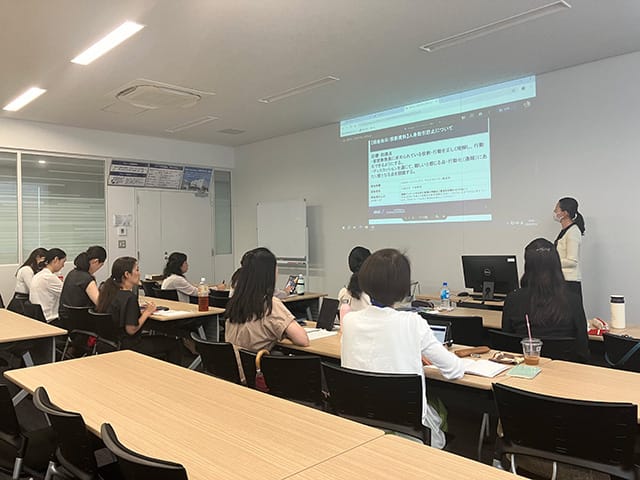
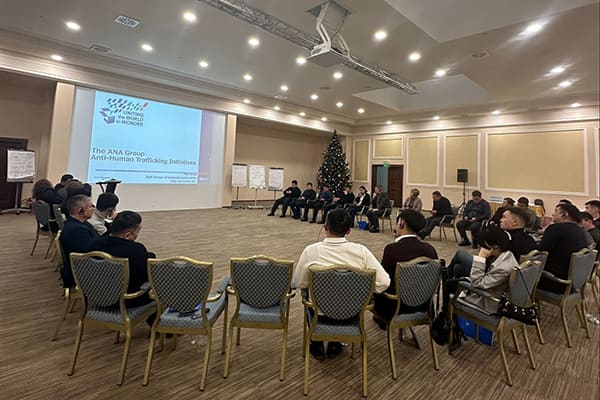
In 2024, we conducted education and discussions for approximately 8,000 flight attendants belonging to ANA in a conference setting. On July 19th, we also organized a forum. In December, we were the only private airline to participate in a training session on the prevention of human trafficking in the Republic of Kazakhstan, organized by the International Organization for Migration (IOM) Kazakhstan. We gave a presentation on the ANA Group's initiatives and the importance of public-private cooperation as a sector.
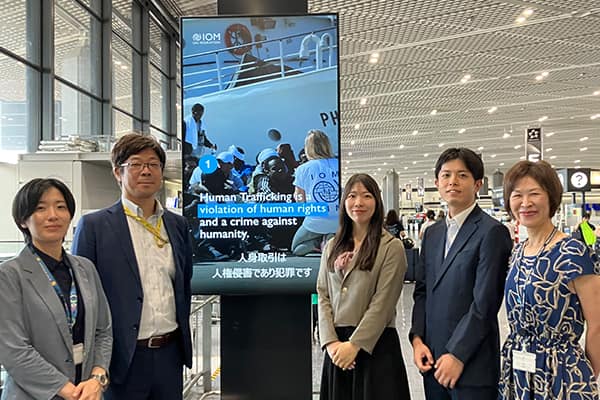
In 2025, with the aim of raising awareness about the current status of human trafficking and strengthening deterrence through collaboration with relevant authorities, awareness-raising videos were displayed on digital signage at Narita International Airport from July 25 to August 31.
Additionally, we facilitated a direct dialogue between cabin crew members and officials from the National Police Agency (NPA). By receiving direct guidance from the NPA regarding feedback from the previous year’s departmental training, we successfully heightened the sensitivity of our frontline staff. Furthermore, we received a message from the Chief of Mission of the International Organization for Migration (IOM) in Japan regarding the IOM's role in preventing human trafficking, latest trends, and a message to ANA Group employees. These insights were integrated and disseminated across the entire Group via the intranet. Through this multi-layered collaboration between the public, private, and international sectors, we continue to build an effective prevention framework and encourage proactive behavior among all employees.
We will strengthen measures to prevent our services from being used to commit human rights violations.
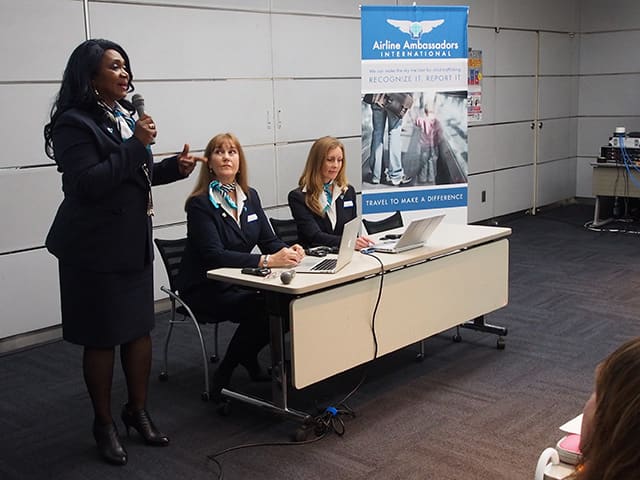
- Airline Ambassadors International
Initially a network of airline employees, Airline Ambassadors International has become an NPO working to prevent human trafficking.
Theme 4: Respect for Human Rights in the Utilization of AI
- Why We Consider This Theme To Be Important
While the ANA Group actively promotes the utilization of AI technologies, we recognize that AI usage involves potential human rights risks, such as algorithmic discrimination, bias, and privacy violations. In accordance with the "ANA Group AI Principles," we aim to maximize the benefits of technology through a human-centric lens. We believe it is our corporate responsibility in a technology-driven society to address the human rights risks posed by AI with a responsible and proactive stance. - Relevant Stakeholders
- ANA Group companies
- ANA Group customers and other stakeholders, etc.
- Initiatives
In 2024, we conducted a dialogue with overseas experts regarding the utilization and governance of AI based on the perspective of "AI and Human Rights." Informed by their advice, in 2025 we formulated the "ANA Group AI Principles" and established an "AI Governance System" to promote the appropriate and ethical utilization of AI.
Please see Dialogue with external experts on AI and Human rights for more detalis
Examples of Responses to Other Human Rights Issues
The following issues will continue to be addressed through our day-to-day management systems, as robust management structures have already been established within the Group.
Promotion of Privacy Governance (Protection of Personal Information)
The ANA Group has established a robust privacy governance framework to ensure that personal data is utilized appropriately, going beyond mere legal compliance to meet evolving societal expectations. Under an organized management structure, we strive for high transparency and continuous risk management to promote data utilization that earns and maintains the trust of our customers.
Corruption Prevention
With regard to anti-bribery measures, we have established the ANA Group Anti-Bribery Rules in order to comply with the anti-bribery laws of each country, and have put in place a system to minimize legal risks on a global level and prevent situations that may lead to a decline in corporate value. At the same time, there is a provision on how to respond when a violation is found. Training on the anti-bribery laws is provided for officers and employees of overseas branches in Japanese and English, along with training on competition laws. In addition, the ANA Group makes contracts with business partners conditional on efforts to prevent bribery and corruption.
Human rights of children
The impact assessment in 2019 identified new issues, such as human rights of children. Based on these results, we held an in-house seminar in December 2020 with the cooperation of Save the Children Japan*, a public interest incorporated association, to better understand the potential risks for the ANA Group in regard to human rights of children.
The reduction in the number of flights from the effect of COVID-19 had given rise to unused in-flight meals. Through Save the Children Japan, the ANA Group donated rice crackers, apple juice, etc. to children from single-parent households in May 2020. To keep children's spirits up while they had to stay out of school due to COVID-19, the ANA Group also donated some 20,000 chocolates to municipalities in the environs of Narita Airport.
- Save the Children Japan
Established in 1919, Save the Children, an international NGO, has been supporting children for over a century. Save the Children Japan was established in 1986 as a member of Save the Children. In partnership with governments and local communities in and outside of Japan, Save the Children Japan works to protect children's rights.
The human rights of our employees
At the ANA Group, we strive to always understand the customers' viewpoint and provide service that exceeds their expectations. On the other hand, we take a firm and resolute stance towards inappropriate actions or excessive demands from customers which reach the level of harassment, as these may significantly harm the rights and working environment of our employees. To ensure that the human rights of our employees and customers are mutually respected and to create a safe and comfortable environment for their use, we will continue to respond in accordance with 'ANA Group Policy on Customer Harassment' policy.
Training our Staff
The ANA Group ensures that all employees of the Group are aware of the Group's human rights initiatives, including our policies. Specifically, education and training on "business and human rights" is provided each year to new employees and new managers. We also provide e-learning programs for all employees of the Group to deepen their understanding of human rights.
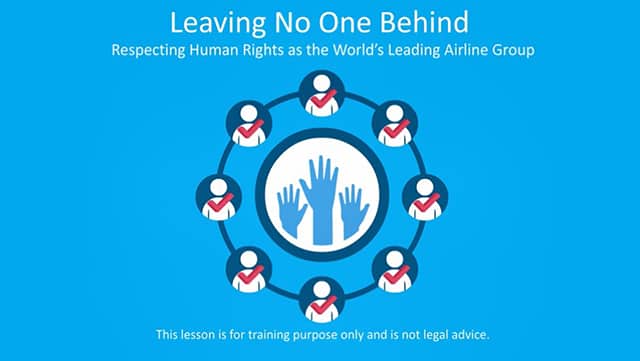
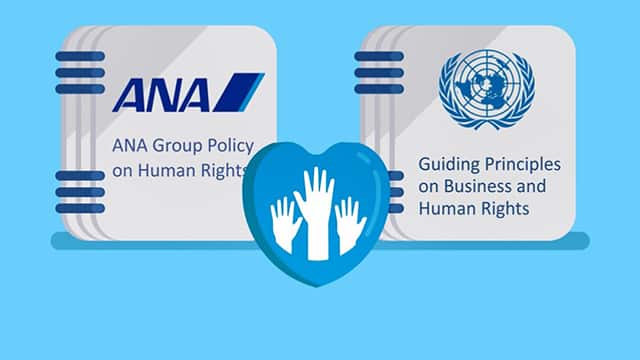
Proprietary materials of ANA Group's in-house education.
- Do not copy or distribute without permission.