Water Efficiency Management
Basic Approach to Water Resource Conservation
Water resources are indispensable and irreplaceable for all life and societal activities. Globally, issues such as over-extraction, pollution, and the degradation of aquatic ecosystems due to development are escalating, presenting a critical environmental risk on par with climate change.
The ANA Group positions water resource conservation as a key priority within its global environmental protection efforts, spanning all business activities including flight operations, in-flight meal preparation, and aircraft maintenance.
Guided by the "ANA Group Environmental Policy," alongside its "Biodiversity Policy" and "Procurement Policy," the Group drives water conservation and stringent water quality management. We remain committed to mitigating water-related risks—including water stress across our domestic and international operational sites—and contributing to the preservation of healthy water environments.
Recognition of Water-Related Risks
For the ANA Group, with its core in airline transportation, the depletion of water resources and intensifying water stress driven by climate change represent critical business risks (both physical and operational) that could impact business continuity. Specifically, three key risk scenarios may manifest across our operations and supply chains:
- (1) Impacts on Aircraft Operations and Maintenance
Substantial volumes of clean water are essential for routine aircraft washing and precision engine cleaning. Should regional water shortages prompt water rationing or conservation mandates, restricted washing could lead to dirt accumulation on aircraft surfaces, increasing aerodynamic drag and impairing fuel efficiency due to reduced engine performance. Furthermore, prolonged washing procedures under water constraints could reduce hangar operational efficiency, restrict fleet availability, and compromise on-time flight performance. - (2) Impacts on Catering Ingredient Procurement and Meal Preparation
Severe droughts causing crop failures can disrupt the stable procurement of ingredients for in-flight meals and inflate costs. Additionally, water shortages at ANA Catering Service (ANAC) facilities and third-party catering partners globally would hinder strict hygiene management, potentially leading to the inability to serve meals or necessitating service reductions. - (3) Impacts on Business Continuity via Deteriorating Workplace Sanitation
Shortages of operational and domestic water risk causing foodborne illnesses, infectious disease outbreaks, and degraded working conditions. The resulting physical and mental burden on personnel, alongside staffing shortages, could force flight reductions or cancellations to maintain our uncompromising focus on safety, ultimately threatening our ability to sustain our critical function as a societal transportation infrastructure.
Business Opportunities in Water Management
At the ANA Group, water conservation and sustainable use are viewed not merely as risk mitigation, but as key business opportunities to bolster competitiveness and organizational resilience. Proactive risk reduction and resource efficiency across the value chain unlock long-term value in the following key areas:
- (1) Enhancing Cost Competitiveness (Reduction of Operational Costs)
Achieving steady reductions in water consumption through the installation of water-saving fixtures and thorough water recycling, thereby continuously lowering utility and overall operational costs. - (2) Stabilizing the Supply Chain (Enhancing Risk Resilience Through Supply Chain Fortification)
Conserving water resources in supplier regions helps safeguard the supply chains for critical materials and goods—including duralumin, semiconductors, paper products, and food ingredients. Establishing a resilient procurement structure immune to price spikes or material shortages enhances business stability and corporate reliability. - (3) Maintaining Operational Quality and Enhancing Brand Value (Securing Competitiveness via Fuel Efficiency and Fleet Aesthetics)
Securing sufficient water resources to perform high-quality engine and aircraft washing ensures optimal fuel efficiency and maintains the aesthetic appearance of the fleet, thereby earning sustained trust from stakeholders and securing medium-to-long-term business stability.
Scope of Management
Water use occurs at all ANA Group business sites. We manage water usage at approximately 250 sites to reduce consumption
| Airport facility | Training Center | Maintenance Center |
| Sales branches building | Catering Factory | Call Center |
| Data Management Centers | Others |
Initiatives for Water Consumption Reduction
Under the "ANA Group Environmental Policy," the ANA Group utilizes GreenGlobeX (GGX)—a group-wide environmental performance management system—to visualize, analyze, and evaluate water consumption across its operational sites.
At our facilities, unused potable water recovered from aircraft post-flight is repurposed for ground cleaning and other maintenance tasks, alongside the active utilization of reclaimed water treated from kitchen wastewater. In aircraft maintenance, the implementation of ultra-high-pressure water cleaning technology for engine parts simultaneously reduces chemical detergent usage and minimizes water consumption. Furthermore, through the proper operation of wastewater treatment facilities, we maintain operational practices that rigorously minimize environmental impacts on local water bodies.
- All data based on these figures have been verified and certified by LRQA PDF Opens in a new window.In the case of an external site,it may or may not meet accessibility guidelines. Limited.
Initiatives at ANA Catering Service
ANA Catering Service Co., Ltd. (ANAC), which oversees in-flight meal preparation, operates three main catering facilities that consume substantial water resources, accounting for approximately 30% of the total water used across the Group’s roughly 250 domestic sites. ANAC actively drives continuous water reduction and proper wastewater management across these key facilities through the following water management programs:
Water Management Program
- (1) Visualization and Progress Management via GGX
Daily water consumption is visualized using the group-wide environmental performance management system, GreenGlobeX (GGX), enabling precise tracking of usage patterns and data-driven progress management. - (2) Target Setting Tailored to Facility Characteristics
Based on historical usage analysis, customized annual reduction targets are established for each plant, accounting for specific operational environments and past performance. - (3) Adoption of Water-Saving Equipment and Integration into Capital Investment Plans
Water-saving valves and fixtures are installed on equipment such as washing machines, with performance effectiveness regularly evaluated. The verified outcomes are integrated into future equipment replacement and capital investment plans to drive continuous goal achievement. - (4) Recovery and Utilization of AC Condensate Water
Condensate water generated from air conditioning units is recovered and repurposed for spraying on plant roofs and outdoor AC units. This serves as a thermal management (energy-saving) measure that mitigates building heat buildup while reducing municipal water consumption for cooling. - (5) Stringent Wastewater Management and Water Quality Improvement
Wastewater pretreatment facilities are operated to comply with strict discharge standards. Monthly inspections and water quality testing are conducted to ensure continuous process improvements and safeguard local aquatic environments.
For more information
Employee Education on Environmental Issues
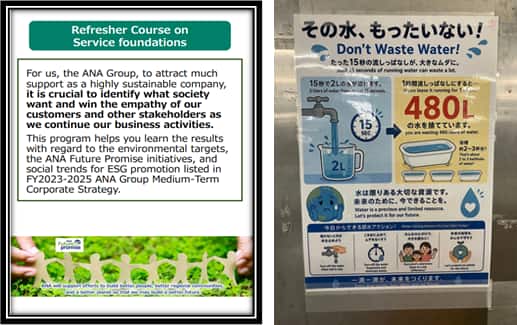
The ANA Group conducts environmental e-learning programs for employees several times a year. The objective is to ensure that employees understand the importance of promoting ESG, enabling them to provide appropriate guidance and take proper action when serving customers.
These educational programs are also utilized to facilitate understanding of environmental targets, progress, and various initiatives, including water efficiency management.
Example: Internal Training Materials