Waste Management
Policy
We consider environmental issues important in our business and promote initiatives to manage and reduce waste through our business operations per our policies.
Risks and Opportunities
In the ANA Group, whose core business is airline operations, in-flight meals and supplies, which are indispensable to customer service, always generate waste. This waste contributes to significant environmental challenges, including ocean plastic pollution and food waste, leading to the deterioration of natural environments and ecosystems. This has a significant impact on procurement, which is essential for business operations.
The ANA Group promotes 3R (Reduce/Reuse/Recycle) + R (Renewable) initiatives to reduce the use of paper and plastic resources and to reduce and recycle food waste in accordance with regulations such as the Containers and Packaging Recycling Law, the Law for Promotion of Plastic Recycling, and the Food Recycling Law. We believe that our contribution to the circular economy will also reduce CO2 emissions from waste incineration, thereby contributing to the reduction of environmental burdens.
SCOPE of Management
We conduct audits through a third-party verification organization (LRQA) based on the management of the overall waste generated by our business activities.
The ANA Group considers environmental issues such as marine plastics and food loss to be important, and as part of our resource recycling efforts, we are managing (reducing) plastic, paper, and food waste.
Waste Management Scope
| Management scope | Description |
|---|---|
| Third-party audit | Audits are conducted through a third-party verification organization (LRQA). |
| Main waste streams managed | Plastic, paper, and food waste |
| Management basis | Overall waste generated by business activities |
Management Program for Waste Reduction
The ANA Group has created its own "Energy Management Standard" and established an environmental management system based on ISO 14001, the Energy Conservation Law, and the Law for Promotion of Plastic Waste Recycling. This management standard is programmed for efficiency management, including data management, evaluation, improvement, planning (target setting), and action in "energy," "water," and "waste”.
Waste Management Programs
- Waste audits to identify opportunities for improving waste performance: We conduct audits through a third-party verification organization (LRQA) based on the management of the overall waste generated by our business activities.
- Action plans to reduce waste generation: Our management standard includes data management, evaluation, improvement, planning (target setting), and action for waste management.
- Quantified targets to minimize waste: We have established quantified targets to reduce the resource waste ratio and food waste ratio by FY2030.
- Innovation initiatives to minimize waste: We are promoting practical initiatives such as plant-derived materials for in-flight meal containers, AI-based meal pre-booking services, digitalization to reduce paper use, and collaborative development of upcycled paper materials.
- Integration of recycling programs: We promote 3R (Reduce/Reuse/Recycle) + R (Renewable) initiatives in accordance with regulations such as the Containers and Packaging Recycling Law, the Law for Promotion of Plastic Recycling, and the Food Recycling Law.
ANA Group Environmental Targets from FY2021
Quantified Targets to Minimize Waste
| Indicator | FY2030 Target | Latest Actual |
|---|---|---|
| Reduce Resource Waste Ratio (Plastics, Paper, etc) | 70%+ reduction vs. disposal volume in FY2019 | FY2025: 64.2% reduction |
| Reduce Food Waste Ratio (Including In-Flight Meals, etc) | Reduce to less than 3.8% | FY2025: 3.9% |
Environmental Targets and Information Disclosure
For details on the actual figures,
- All data based on these figures have been verified and certified by LRQA PDF Opens in a new window.In the case of an external site,it may or may not meet accessibility guidelines. Limited.
Initiative 3R(Reduce/Reuse/Recycle)+R(Renewable)
Examples of Waste Reduction and Resource Circulation Initiatives
The ANA Group promotes 3R (Reduce/Reuse/Recycle) + R (Renewable) initiatives to reduce the use of paper and plastic resources and to reduce and recycle food waste.
Examples include the use of plant-derived materials for international economy class in-flight meal containers, AI-based meal pre-booking services to reduce food waste, digitalization of in-flight magazines and other materials to reduce paper waste, and collaborative development of upcycled paper materials.
| Reduce Resource Waste Rate |
|
|---|---|
|
|
|
|
| Reduce Food Waste Rate |
|
| Recycling of Food Resources | |
|
For more information
Employee Education on Waste and Environmental Issues
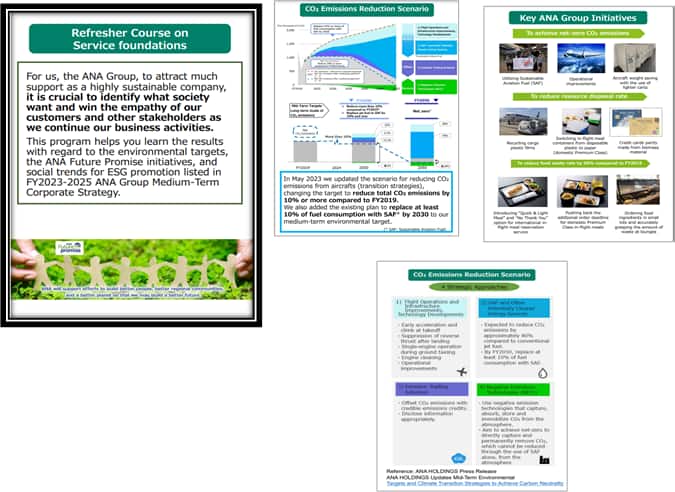
The ANA Group conducts e-learning programs on the environment several times a year to help employees understand the importance of ESG promotion and to enable them to provide appropriate guidance and take appropriate actions when dealing with customers. These educational programs also support employee awareness of environmental targets, progress, and initiatives, including waste management and resource circulation.
Example: Internal Training Materials