
- Please select the card you wish to join
-
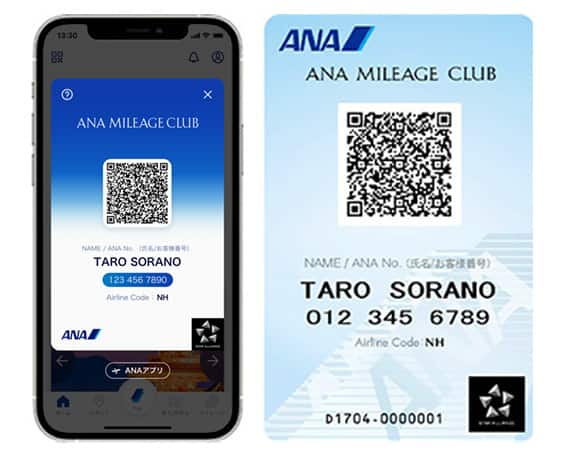
Get your digital card immediately
No enrollment or annual fees
ANA Mileage Club Card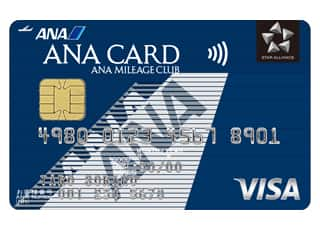
Earn more miles for your money
With credit function
ANA Card
Baggage (Check-in Procedures, Carry-on, Inspections) (Japan Domestic Flights)
This page provides information about the rules and points to note which need to be confirmed in advance concerning baggage when boarding a Japan domestic flight.

Information
Our Requests to Passengers Regarding Carry-on Baggage and Personal Items (Applicable to flights boarding on/after July 1, 2026)
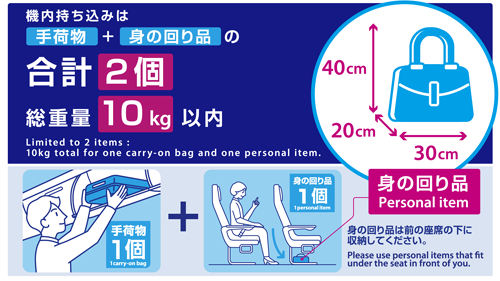
On ANA Group-operated flights, passengers may bring up to two items into the cabin: one piece of carry-on baggage and one personal item.
Starting July 1, 2026, the maximum size for personal items on ANA Group-operated flights will be updated to within 40cm x 30cm x 20cm.
To ensure smooth boarding, on-time performance, and enhanced cabin safety (reducing the risk of passenger injuries caused by falling baggage), we kindly ask for your understanding and cooperation with the following rules.
We appreciate your understanding and cooperation.
-
*
This size update applies only to “personal items” (e.g., handbags, shoulder bags). The size of “carry-on baggage” (e.g., suitcases) remains unchanged. Please see the comparison below.
| Carry-on Baggage (No change) |
Personal Item (Size updated) |
|
|---|---|---|
| Typical examples | Suitcase, carry case, etc. | Handbag, shoulder bag, etc. |
| Number of Pieces | 1 | 1 |
| Size |
|
Within 40cm x 30cm x 20cm (from July 1, 2026) |
| Weight | Total Weight: Up to 10 kg (Combined weight of carry-on baggage and personal items) |
|
| Where to stow | Overhead compartment / Under the seat in front of you | Under the seat in front of you |
Applicable to flights boarding on/after July 1, 2026
-
Personal items must be within 40cm x 30cm x 20cm and small enough to fit completely under the seat in front of the passenger.
Applicable to flights boarding on/after April 1, 2026
-
Passengers may bring up to two items into the cabin: one carry-on bag and one personal item(e.g., handbag, shoulder bag, etc.).
-
Personal items must be small enough to fit completely under the seat in front of the passenger.
-
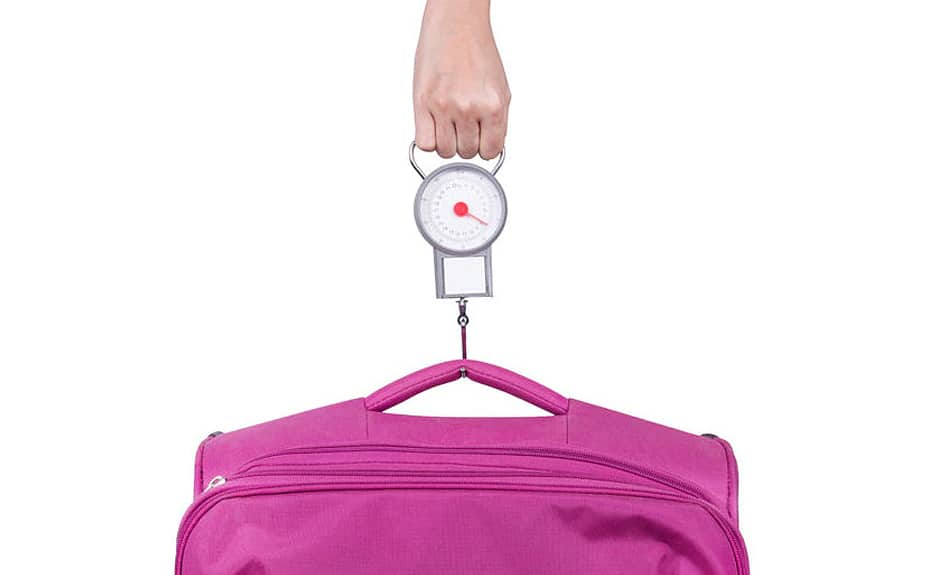
In addition to meeting size and weight regulations, passengers are requested to bring only baggage that they can lift and stow in the overhead compartment without assistance.
This update is based on the industry-wide guidelines for carry-on baggage established by the Scheduled Airlines Association of Japan, following administrative notice from the Civil Aviation Bureau of the Ministry of Land, Infrastructure, Transport and Tourism.
For details on the size and number of carry-on baggage items (such as suitcases) allowed, please see:
Changes to the Handling of Power Banks (Applicable to flights boarding on/after April 24, 2026)
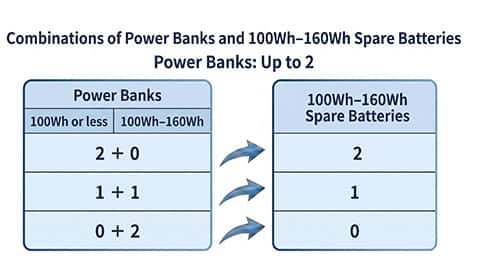
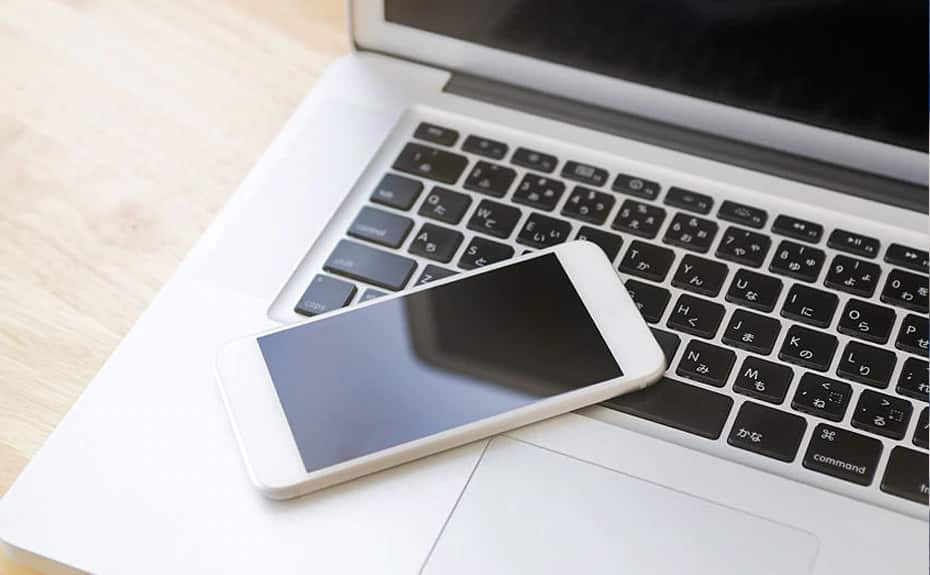
In accordance with changes to international standards established by the International Civil Aviation Organization (ICAO) and revisions to guidelines issued by the Ministry of Land, Infrastructure, Transport and Tourism, the rules regarding the number of power banks allowed on board and charging will be changed as follows.
-
Can not be checked in as checked baggage.
-
Bring in items with a watt-hour rating of 160 Wh or less.
-
Bring in up to 2 items per person.
-
To prevent short circuits, please protect the terminals with tape or place them in a plastic bag to ensure proper isolation.
-
Charging power banks using the in-flight power outlet is prohibited.
-
Refrain from using power banks to charge other electronic devices.
We appreciate your understanding and cooperation as we strive to provide pleasant and comfortable flights.
Transport of Lithium Battery-powered Electronic Devices Subject to Recall
The Civil Aviation Bureau of the Ministry of Land, Infrastructure, Transport and Tourism of Japan has notified airlines of the standards for the transport of lithium batteries subject to recall and electronic equipment containing such batteries.
For details, please refer to "Transport of Lithium Battery-powered Electronic Devices Subject to Recall".

Notes
-
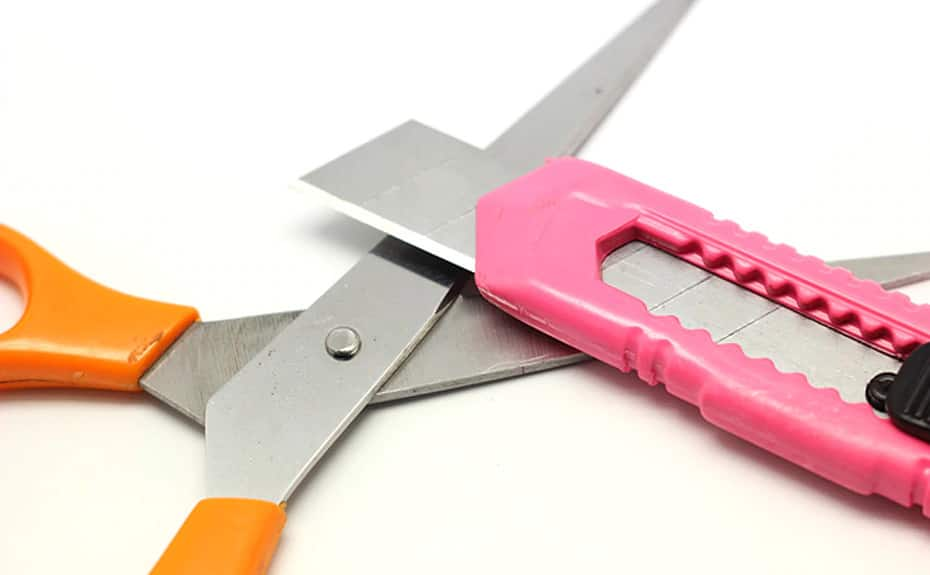
Please note that sharp objects such as scissors, knives and cutters are not permitted to be carried on board. We kindly ask that you check in these items at a baggage drop counter before departure.
-
Please note that certain items are not permitted to be checked in or carried on board. Please see the typical examples of dangerous goods which are not permitted to be checked in or carried on board (website of Japan's Ministry of Land, Infrastructure, Transport and Tourism).
Services for a Safe and Comfortable Flight


Frequently Asked Questions
Related Tags





Member Login
Information for Members Logging In
- Before proceeding to log in, please be sure to read and accept the section on the purpose of using personal information in the ANA Privacy Policy.
- Points to note when using your AMC account.
Auto-Login with Cookies
- However, you will need to re-enter your password as a form of verification when making reservations, requesting awards, registering/revising personal information, and using other members-only functions.
-
The confirmation screen will reappear after closing all browser windows even if you checked "Do not show this screen again."
Entry of One-Time Password
If you have not received your one-time password
If your one-time password does not come through, please check your settings for receiving it and then re-send it.
If you do not do anything on the screen for a certain amount of time, you will have to request another one-time password.
Select your desired destination email address.
Do you really want to log out?
- If you click "Log Out," you will be logged out even if you have selected "Save Login Status."
- Close all open browser windows if you want to quit your session without logging out.
-
The confirmation screen will reappear after closing all browser windows even if you checked "Do not show this screen again."

ANA Biz is a business travel arrangement service.

-
MILES
-
ANA SKY COINS
-
Premium Point / Point on ANA /
-
Reservations
-
MILES
-
MILES
-
Login
-
Support