
データが取得できませんでした
- Please select the card you wish to join
-
Get your digital card immediately
No enrollment or annual fees
ANA Mileage Club Card
Earn more miles for your money
With credit function
ANA Card
-
Reservations
-
MILES
-
MILES
-
Login
-
Support
Seoul(Gimpo)
on February 25th, 2026 (JST) current information
Immigration and Visa
Visa
No visa is required for stays of up to ninety days for tourism, but visitors aged 18 to 64 must receive Korea Electronic Travel Authorization (K-ETA) in advance. (As a temporary campaign, Japanese passport holders do not require a visa for the period until December 31, 2026). It is recommended to apply for authorization within three days before departure. Authorization is valid for 3 years, and you do not generally need to be re-authorized during that period.
Electronic Arrival Card
Instead of the regular paper-based arrival card, starting in January 2026, you can create an e-Arrival Card online. Declarations can be made up to 3 days before arriving in the Republic of Korea.https://www.e-arrivalcard.go.kr/portal/main/index.do?locale=JP
Passport
An existing validity period of at least 3 months from the time of entry is recommended when entering the country.
Quarantine
When visiting from Japan, you must declare when bringing the following items into South Korea.
- Animals, livestock products, meat (including skin or fur), animal products, plants, or vegetables. Seafood, agricultural products and other food products, seeds, or soil.
- Live pathogens and pests (including pet insects)
Customs
Bringing in e-cigarettes
The scope of tax exemptions on e-cigarettes for travelers is up to 200 cigarettes or 20 ml of liquid. For all other types of e-cigarettes, up to 110 g. E-cigarettes are not tax free for travelers under age 19.
For bringing and possession of tax-free cigarettes
- Liquor: 2 bottle (total volume less than 2L, total price under $400)
- Tobacco: 200 cigarettes or e-cigarette nicotine solution 20ML (with nicotine content less than 1%)
- Perfume: 100ml
- Alcohol and tobacco products are not tax free for travelers under age 19.
Time difference and Daylight Saving Time
Time difference
There is no time difference between Japan and South Korea. Neither is daylight saving time observed, so the time in South Korea is the same as Japan throughout the year.
Climate
Climate
South Korea’s climate can be considered nearly identical to the northern to central regions of Honshu in Japan. There are four distinct seasons and a rainy season. Usually, visitors from Japan can wear the same type of clothing as they wore in Japan at the time of their departure. Winter is quite cold, so precautions against the cold must be taken. Generally, the disparity between cold and warm temperatures is more extreme than Japan.
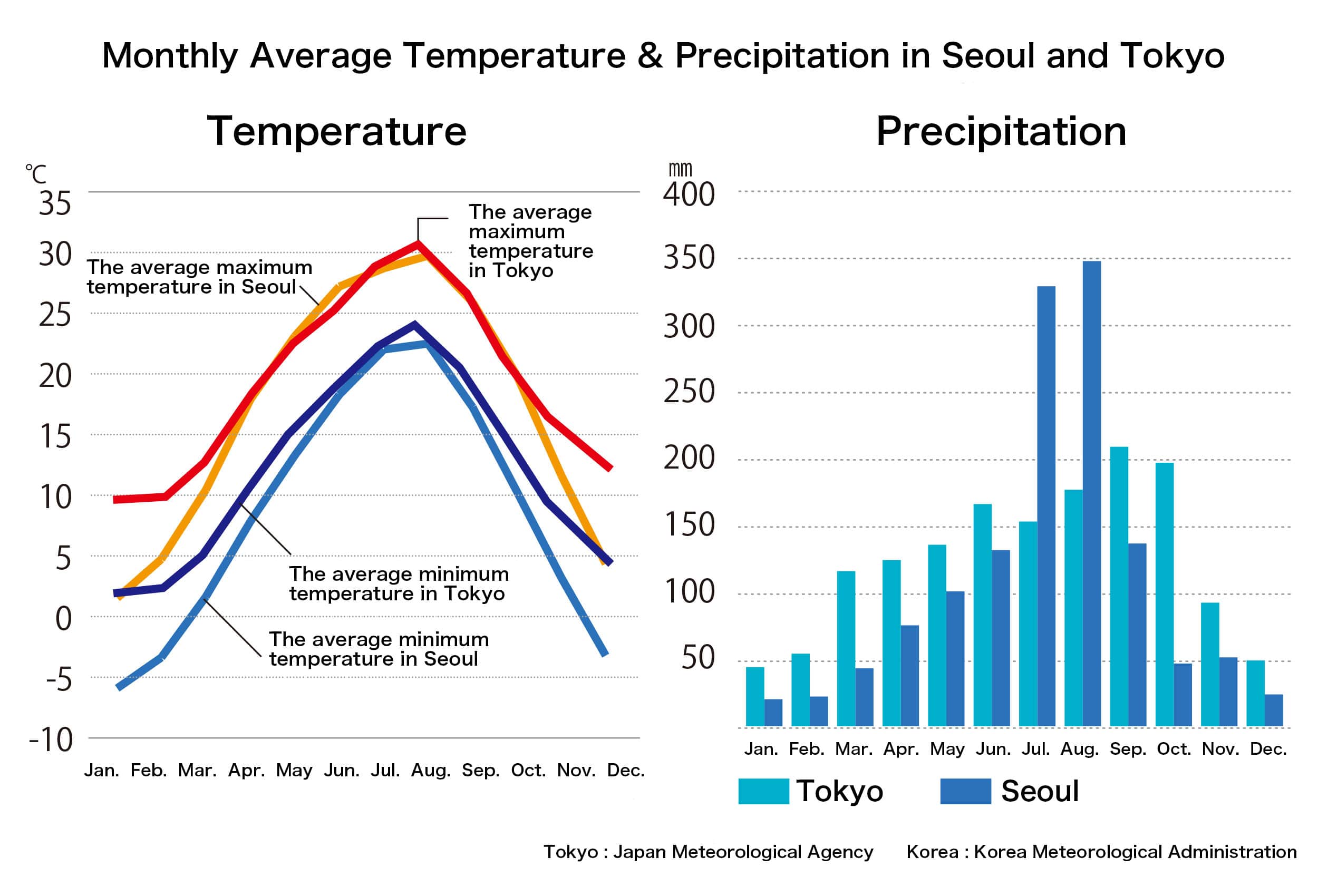
Monthly Average temperature & Precipitation in Seoul and Tokyo
-
Monthly average temperature and precipitation
The average maximum temperature in Tokyo and Seoul, The average minimum temperature in Tokyo and Seoul
month The average maximum temperature in Tokyo The average minimum temperature in Tokyo The average maximum temperature in Seoul The average minimum temperature in Seoul Jan. 10℃ 2℃ 2℃ -6℃ Feb. 10℃ 2℃ 3℃ -4℃ Mar. 13℃ 5℃ 8℃ 0℃ Apr. 18℃ 10℃ 15℃ 5℃ May 23℃ 15℃ 24℃ 12℃ Jun. 25℃ 18℃ 27℃ 15℃ Jul. 28℃ 23℃ 28℃ 22℃ Aug. 31℃ 24℃ 30℃ 22℃ Sep. 27℃ 21℃ 26℃ 15℃ Oct. 23℃ 15℃ 20℃ 8℃ Nov. 17℃ 10℃ 13℃ 2℃ Dec. 13℃ 5℃ 4℃ -3℃ The average precipitation in Tokyo and Seoul
month The average precipitation in Tokyo The average precipitation in Seoul Jan. 50mm 30mm Feb. 60mm 40mm Mar. 120mm 50mm Apr. 130mm 80mm May 130mm 100mm Jun. 170mm 150mm Jul. 160mm 330mm Aug. 150mm 340mm Sep. 210mm 130mm Oct. 160mm 50mm Nov. 90mm 60mm Dec. 50mm 30mm
Currency and Exchange Rate, Tax, Currency exchange, Tip
Currency and Exchange Rate
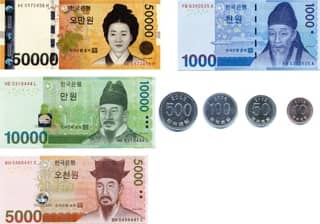
South Korean banknotes and coins
The unit of currency is the won, abbreviated as W. As of March 12, 2026, W100 is equal to approx. JPY10.74. There are four denominations of banknotes: W50000, W10000, W5000, and W1000. There are seven types of coins: W500, W100, W50, W10 (new and old), W5, and W1.
Tax
Consumption activities are subject to a 10% value added tax (VAT). The minimum duty-free purchase amount was lowered to W15,000 in 2024. Foreign tourists can receive a tax refund by completing a procedure at a store with a TAX FREE symbol. You cannot get a refund for food and drink costs at restaurants that are not eligible for a tax refund.
Tip
Tipping is not required. A service charge is added in advance to expenses such as meal charges at upscale establishments and room fees at hotels. It is acceptable to tip when receiving a special or excessive service.
Voltage and plug
Voltage
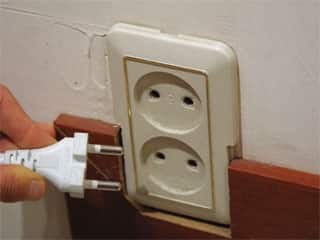
A 220V outlet
In South Korea, the voltage is 220V and outlets are mostly the same shape as Europe, type SE (that also fit type C plugs). In Japan, the voltage is 100V and outlets are type A, so a plug adapter or transformer is needed when using Japanese electronics there. Japanese electronics that are also compatible with 220V only require a plug adapter and not a transformer.
Video and DVD
Video and DVD
The DVD region code is 2 in Japan and 3 in South Korea. When buying DVDs, get ones that are region free (all region). DVDs cannot be played on store-bought DVD players with a different region code. The region code can be changed on computers, but usually only up to 5 times.
Blu-ray system
For Blu-ray, both Japan and South Korea are region A, so Blu-rays bought in South Korea can be played normally in Japan.
International postage rates to Japan are as follows.
International Postal Fees to Japan
- Postcards sent by airmail are W430.
- Sealed Letters up to 10g sent by airmail are W570.
- Small packages(Airmail) : up to 100g W4,460, up to 200g W4,990, up to 1kg W10,680
- International small parcels: W9,900 for up to 1 kg and W15,500 for up to 2 kg by sea. Airmail is W17,000 for up to 500 g, W18,000 for up to 1 kg, W19,500 for up to 1.5 kg, and W21,000 for up to 2 kg
- K-Packet: W4,550 for up to 100 g, W5,730 for up to 200 g, and W14,090 for up to 1 kg
- EMS non-documents: W23,500 for up to 500 g
A separate postal fee is now required for international airmail. The fee is W40 per 100 g when sending airmail to Japan. You can buy stamps at post offices as well as some stationery shops. It is best to send parcels by EMS (Express Mail Service) or K-Packet from the post office (or from certain department stores and souvenir shops that will ship it for you).
Phone Call
How to phone
Telephoning Japan from South Korea
Telephoning Japan from South Korea
Ex. When calling (03) 1234-5678 or (090) 1234-5678
STEP1
dial 001 or 002 or 005 or 008 or 00700 (International telephone identification numbers)
STEP2
81 (Country Code, Japan )
STEP3
3 or 90 (Remove the first 0 for area codes and mobile telephone numbers)
STEP4
1234-5678 (Other parties telephone No.)
Telephoning South Korea from Japan
Telephoning South Korea from Japan
Ex. When calling Seoul (02) 123-4567
STEP1
010 (International Identification No.)
STEP2
82 (Country Code, South Korea)
STEP3
2(Area code, remove first 0)
STEP4
123-45678 (Other parties telephone number)
- Pre-registration to World Call is required for NTT DoCoMo.
Holiday / National holiday
Holiday / National holiday
South Korean national holidays include those according to the Gregorian calendar and those according to the lunar calendar. Dates of holidays according to the lunar calendar change each year. There are three: the Korean New Year (lunar New Year), Buddha's birthday, and Chuseok (similar to the Bon festival of the lunar calendar in Japan).
2026
- January 1: New Year's Day
- February 16 to 18: Seollal holidays (Korean New Year; Seollal Day is February 17)
- March 1: March First Day (Independence Movement Day); March 2: Substitute holiday
- May 5: Children's Day
- May 24: Buddha's Birthday
- June 6: Memorial Day
- August 15: Gwangbokjeol (Liberation Day)
- September 24 to 26: Chuseok holidays (including a substitute holiday; Chuseok Day is September 25)
- October 3: Gaecheonjeol (National Foundation Day); October 5 (Substitute holiday)
- October 9: Hangeul Proclamation Day
- December 25: Christmas Day
Language
Language
The official language is Korean. Hangul, a system of phonetic characters created in the 15th century.
Business hours, etc
Business hours
Banks
Mon. to Fri. 9:00 to 16:00, closed on Sat., Sun., holidays. Money can be exchanged during business hours.
Post Office
Mon. to Fri. 9:00 to 18:00 (Banking services open to 16:30), closed Sat., Sun., holidays. Government offices are also closed on Saturdays.
Shops
Generally open around 10:00 to 20:00. Many buildings devoted to fashion-related shops are open until very late at night. Many shops close on the Chinese New Year and on Chuseok.
Restaurants
Generally open around 10:00 to 23:00. Many shops close on the Chinese New Year and on Chuseok.
Age Limit
It is prohibited to sell tobacco or alcohol or allow entry into casinos to persons under 19 years of age.
Related Tags





ANA MILEAGE CLUB
Member Login
Information for Members Logging In
- Before proceeding to log in, please be sure to read and accept the section on the purpose of using personal information in the ANA Privacy Policy.
- Points to note when using your AMC account.
Auto-Login with Cookies
- However, you will need to re-enter your password as a form of verification when making reservations, requesting awards, registering/revising personal information, and using other members-only functions.
-
The confirmation screen will reappear after closing all browser windows even if you checked "Do not show this screen again."
Entry of One-Time Password
If you have not received your one-time password
If your one-time password does not come through, please check your settings for receiving it and then re-send it.
If you do not do anything on the screen for a certain amount of time, you will have to request another one-time password.
Select your desired destination email address.
Do you really want to log out?
- If you click "Log Out," you will be logged out even if you have selected "Save Login Status."
- Close all open browser windows if you want to quit your session without logging out.
-
The confirmation screen will reappear after closing all browser windows even if you checked "Do not show this screen again."

ANA Biz is a business travel arrangement service.

-
MILES
-
ANA SKY COINS
-
Premium Point / Point on ANA /
-
Reservations
-
MILES
-
MILES
-
Login
-
Support