
データが取得できませんでした
- Please select the card you wish to join
-
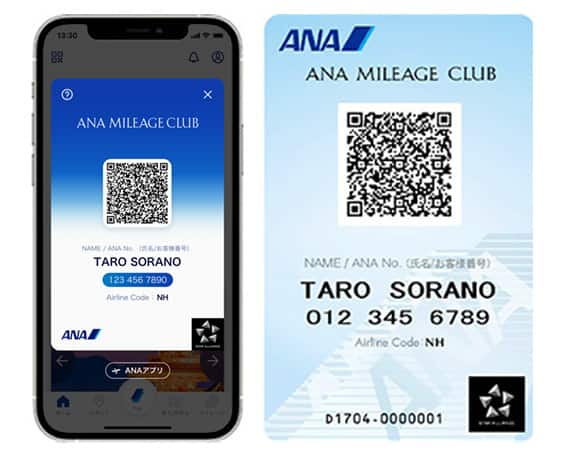
Get your digital card immediately
No enrollment or annual fees
ANA Mileage Club Card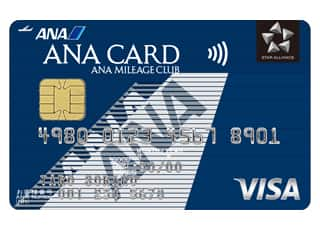
Earn more miles for your money
With credit function
ANA Card
-
Reservations
-
MILES
-
MILES
-
Login
-
Support
Vancouver
on March 6th, 2026 (JST) current information
Immigration and Visa
Visa
Not required for tourist visits of 6 months or less. You must obtain an eTA through the Electronic System for Travel Authorization.
Passport
Your passport must be valid until at least one day following the scheduled date of departure from Canada.
Note for travel to Canada
eTA
From March, 2016, you are required to have an Electronic Travel Authorization (eTA) when traveling to Canada by plane. It costs $7 and is valid for up to five years. If your passport expires during that period, it is valid until the expiration date. You can apply for an eTA online, and you must give your passport and credit card information and e-mail address. You should apply as early as possible soon after your plans to travel to Canada have been fixed. The application procedure is only in English and French, but information is also available in Japanese. It is also required when stopping in Canada in transit on your way to another country by plane. Apply for an eTA(The official website of the Government of Canada)
Quarantine
When visiting from Japan, bringing the following items into Canada is prohibited or restricted.
- a. Live or cooked meat, fruit, vegetables, milk, and other food products
- b. Plants, processed products made from wood, woodchips, foliage plants, firewood, seeds, bulbs, and other plants
- c. Soil or shoes covered in dirt
- d. Live animals including pets
- e: Fish bait
Customs
Bringing in e-cigarettes
Exemption for tobacco sticks is up to 200 sticks, same as regular cigarettes.
For bringing and possession of tax-free cigarettes
- Alcohol: any one of the following: wine 1.5L, beer 8.5L or other 1.14L
- Tobacco: any one of the following: 200 cigarettes, pipe tobacco 200g or 50 cigars
- Gifts: $60 each
- Alcohol and tobacco products may only brought in if you are 18 or 19 (varies by province) or older for alcohol products or 18 or older for tobacco products.
Time difference and Daylight Saving Time
Time difference
There are 6 time zones in Canada. There is a difference of 4.5 hours between the far-eastern Newfoundland Standard Time and far-western Pacific Standard Time. Newfoundland Standard Time is 3.5 hours behind Greenwich Mean Time (GMT). Vancouver is 12.5 hours behind Japan.The time difference will increase by one hour as you cross each time zone moving from east to west. (The time difference to Japan becomes larger.) Daylight saving takes place from the second Sunday of March to the first Sunday of November, when clocks move forward by one hour.
Climate
Climate
Because of its expansive land area, Pacific coastal areas like Vancouver have a large volume of rain. The cold of the Canadian Rockies is very harsh and a jacket is required even in summer if the weather turns. There is a huge temperature difference between warm and cold in Calgary and other places in the prairies. The area around the Great Lakes has four distinct seasons. Areas further East have cool summers and relatively warmer winters. The Far North region around the Arctic Circle is very cold all year round.

-
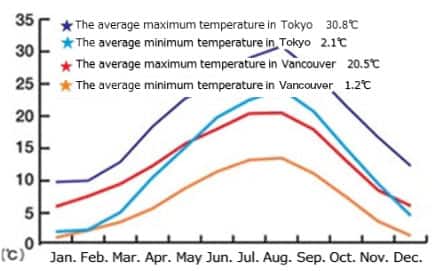
Monthly average temperature and precipitation
The average maximum temperature in Tokyo and Vancouver, The average minimum temperature in Tokyo and Vancouver
Month The average maximum temperature in Tokyo The average mimimum temperature in Tokyo The average maximum temperature in Vancouver The average mimimum temperature in Vancouver Jan. 10℃ 2℃ 6℃ 1℃ Feb. 10℃ 2℃ 7℃ 3℃ Mar. 13℃ 5℃ 8℃ 4℃ Apr. 18℃ 10℃ 11℃ 5℃ May 23℃ 15℃ 15℃ 9℃ Jun. 25℃ 18℃ 18℃ 11℃ Jul. 28℃ 23℃ 20℃ 12℃ Aug. 31℃ 24℃ 20℃ 13℃ Sep. 27℃ 21℃ 18℃ 11℃ Oct. 23℃ 15℃ 13℃ 8℃ Nov. 17℃ 10℃ 8℃ 4℃ Dec. 13℃ 5℃ 7℃ 1℃ The average precipitation in Tokyo and Vancouver
Month The average precipitation in Tokyo The average precipitation in Vancouver Jan. 50mm 160mm Feb. 60mm 140mm Mar. 110mm 130mm Apr. 130mm 80mm May 130mm 70mm Jun. 160mm 60mm Jul. 160mm 40mm Aug. 150mm 50mm Sep. 210mm 60mm Oct. 160mm 110mm Nov. 90mm 200mm Dec. 40mm 180mm
Currency and Exchange Rate, Tax, Currency exchange, Tip
Currency and Exchange Rate
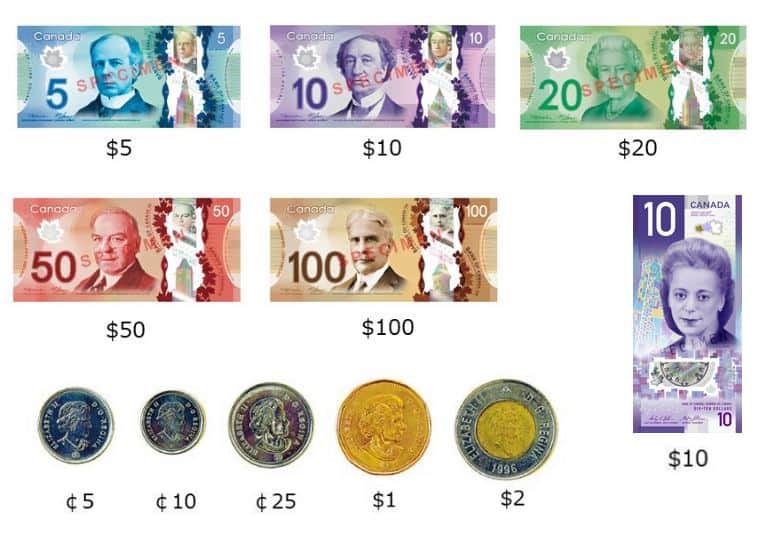
The currency used is the Canadian Dollar; abbreviated as $ or C$ (CAD). Cents (¢) are used as fractional currency. $1 is¢115.16 yen (as of March 6, 2026). The five types of notes issued are $5, 10, 20, 50 and 100. Be aware that some smaller stores may not accept $50 or $100 bills. The five types of coins issued are 5, 10, 25 (quarter), $1 (loonie) and $2.
Tax
A 5% Goods and Services Tax (GST) and a Provincial Sales Tax (PST, rate varies by province) are levied on goods, accommodation, meals, and services. PST in British Columbia where Vancouver is located is 7%. The Yukon, Northwest Territories and Nunavut have only GST, Ontario has only a 13% Harmonized Sales Tax (HST), Prince Edward Island, New Brunswick, and Newfoundland and Labrador have only a 15% HST, and Nova Scotia has only a 14% HST. Goods and accommodation prices shown do not include tax in Canada. There is a separate 3.5 to 8% lodging tax or additional $3 lodging fee in some towns and cities in certain provinces. The tax is higher in large cities and tourist areas.
Tip
It is customary to leave a tip of approximately 15 to 20% when paying for food at a restaurant or for a taxi. A tip is not required when a service charge is included as part of the bill.
Voltage and plug
Voltage
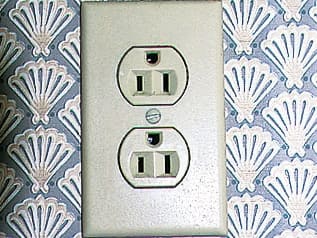
110 to 120 V, 60Hz. Power sockets are almost equivalent to Japan's and uses type A. Since the difference in voltage compared with Japan is only 10 to 20V, most electronic appliances from Japan such as hair dryers and shavers can be plugged in and used as is. Computer related devices can be used without any issues.
Video and DVD
Video and DVD
Canada, like Japan, uses the NTSC standard. Video software brought from Japan can be played smoothly. However, DVDs cannot be played due to the difference in region code (Japan: Region 2, Canada: Region 1).
Blu-ray system
The Blu-ray Disc region code is A in both Japan and Canada, so Canadian media can be played normally on Japanese media players and vice versa.
Postal Charge
When mailing to Japan, airmails including postcards and standard size mails up to 30g are all $3.65. Stamps can be purchased at the post office, as well as at a hotel's front desk and kiosks at a train station, airport or bus depot. The number of days it takes before arrival in Japan differs depending on from where it was mailed, but airmails generally take one to three weeks.
Business Hours
Most post offices are what is called the Postal Outlet inside places such as drugstores, and generally operate from Monday to Friday, between 9:00 to 17:00, Saturday 10:00 to 14:00, and are closed on Sundays. Some places are closed on Saturdays.
Phone Call
How to phone
Telephoning Japan from Canada
Telephoning Japan from Canada
When calling Tokyo (03) 1234-5678
STEP1
dial 011 (International telephone identification number)
STEP2
81 (Country Code, Japan )
STEP3
3 (Remove the first 0 for area codes)
STEP4
1234-5678(Other parties telephone number)
Telephoning Vancouver from Japan
Telephoning Vancouver from Japan
When calling Vancouver (604) 123-4567
STEP1
010 (International Identification No.)
STEP2
1 (Country Code, Canada)
STEP3
604(Area code)
STEP4
123-4567 (Other parties telephone number)
Holiday / National holiday
Holiday / National holiday
In addition to national holidays, there are also state established holidays.
2026
- January 1: New Year's Day
- April 4: Good Friday*1
- April 6: Easter Monday*1
- May 18: Queen Victoria's Birthday*1
- July 1: National Foundation Day (Canada Day)
- September 7: Labor Day*1
- September 30: Truth and Reconciliation Day
- October 12: Thanksgiving Day*1
- November 11: Remembrance Day
- December 25: Christmas Day
- December 26: Boxing Day
- *1.Movable holidays
Language
Language
The two official languages established by Canada are English and French. English and French are spoken as first languages by approximately 50% and 20% of the population respectively. Some states establish different official languages. Aboriginal languages are established as the official languages in the Far North.
Business hours, etc
Business hours
General business hours are as below. There may be a difference of roughly 30 minutes to 1 hour by store.
Banks
Normally from Monday to Friday, between 9:30 to 16:00. Closed on Saturday, Sunday and holidays.
Department Stores and Shops
Monday to Friday between 10:00 to 18:00 (many places are open until 20:00 on Thursdays and Fridays). Open during evenings in areas such as Banff. Shopping centers in suburbs may be open on Sundays.
Liquor Stores
Monday to Saturday, between 9:00 to 18:00. May be open on Sundays in urban areas or during the summer season, and some may be open until around 21:00.
Age Limit
Smoking by persons under 18 years of age, as well as alcohol consumption and casino gambling by persons under 19 years of age (18 for Alberta, Manitoba, Quebec) are prohibited.
In general, rental cars are allowed for persons 25 years of age or over. If under 25 years of age, rent may be denied or may be charged a separate fee.
Smoking
Smoking and alcohol consumption in public places are fully prohibited, with a few exceptions. Restaurant and bars are all non-smoking.
Related Tags





ANA MILEAGE CLUB
Member Login
Information for Members Logging In
- Before proceeding to log in, please be sure to read and accept the section on the purpose of using personal information in the ANA Privacy Policy.
- Points to note when using your AMC account.
Auto-Login with Cookies
- However, you will need to re-enter your password as a form of verification when making reservations, requesting awards, registering/revising personal information, and using other members-only functions.
-
The confirmation screen will reappear after closing all browser windows even if you checked "Do not show this screen again."
Entry of One-Time Password
If you have not received your one-time password
If your one-time password does not come through, please check your settings for receiving it and then re-send it.
If you do not do anything on the screen for a certain amount of time, you will have to request another one-time password.
Select your desired destination email address.
Do you really want to log out?
- If you click "Log Out," you will be logged out even if you have selected "Save Login Status."
- Close all open browser windows if you want to quit your session without logging out.
-
The confirmation screen will reappear after closing all browser windows even if you checked "Do not show this screen again."

ANA Biz is a business travel arrangement service.

-
MILES
-
ANA SKY COINS
-
Premium Point / Point on ANA /
-
Reservations
-
MILES
-
MILES
-
Login
-
Support